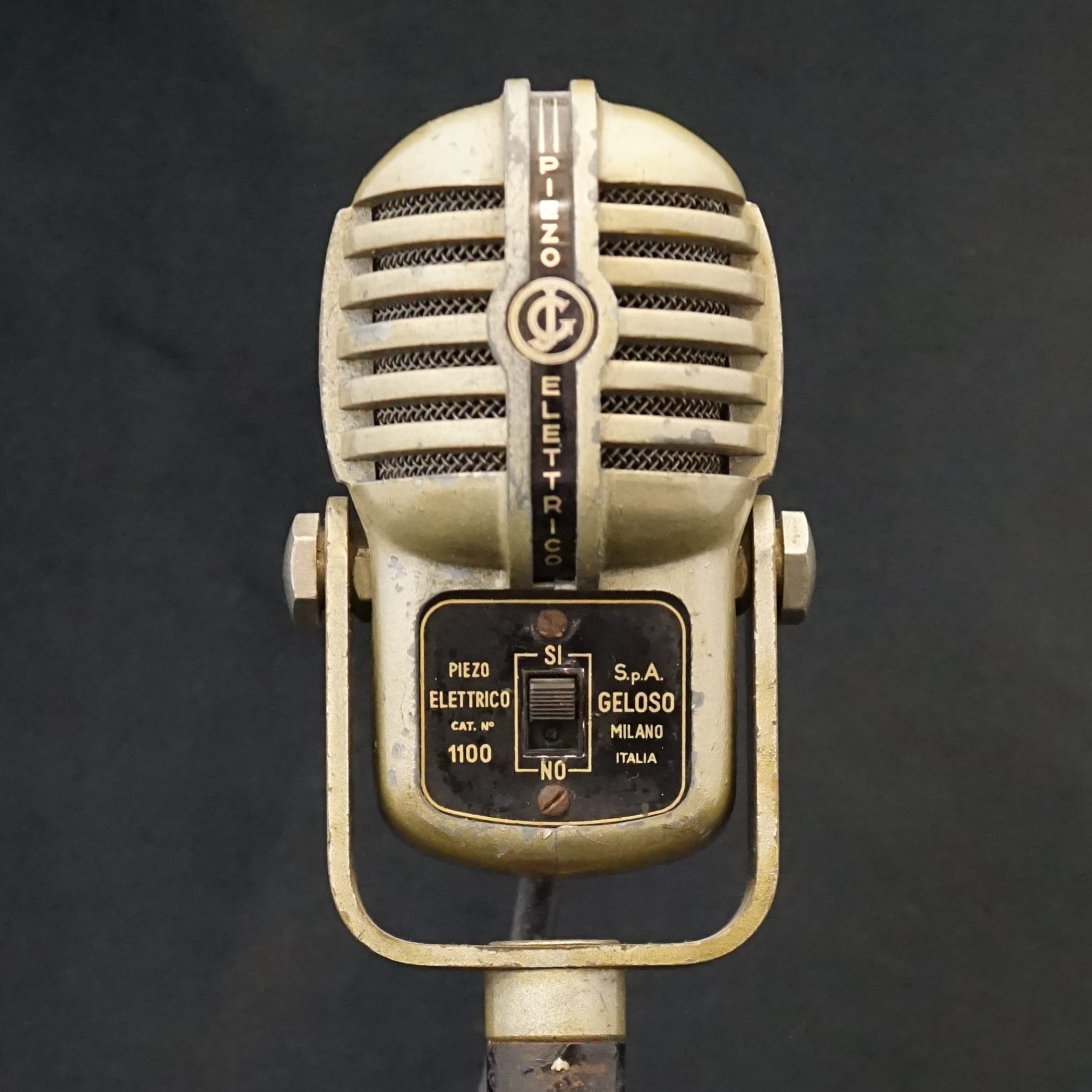
Geloso 416
Manufacturer:
GelosoModel:
416Country of Manufacture:
ItalyMicrophone Type:
RibbonPolar Pattern:
Figure 8Production Start Year:
1951Production End Year:
1956Rarity:
3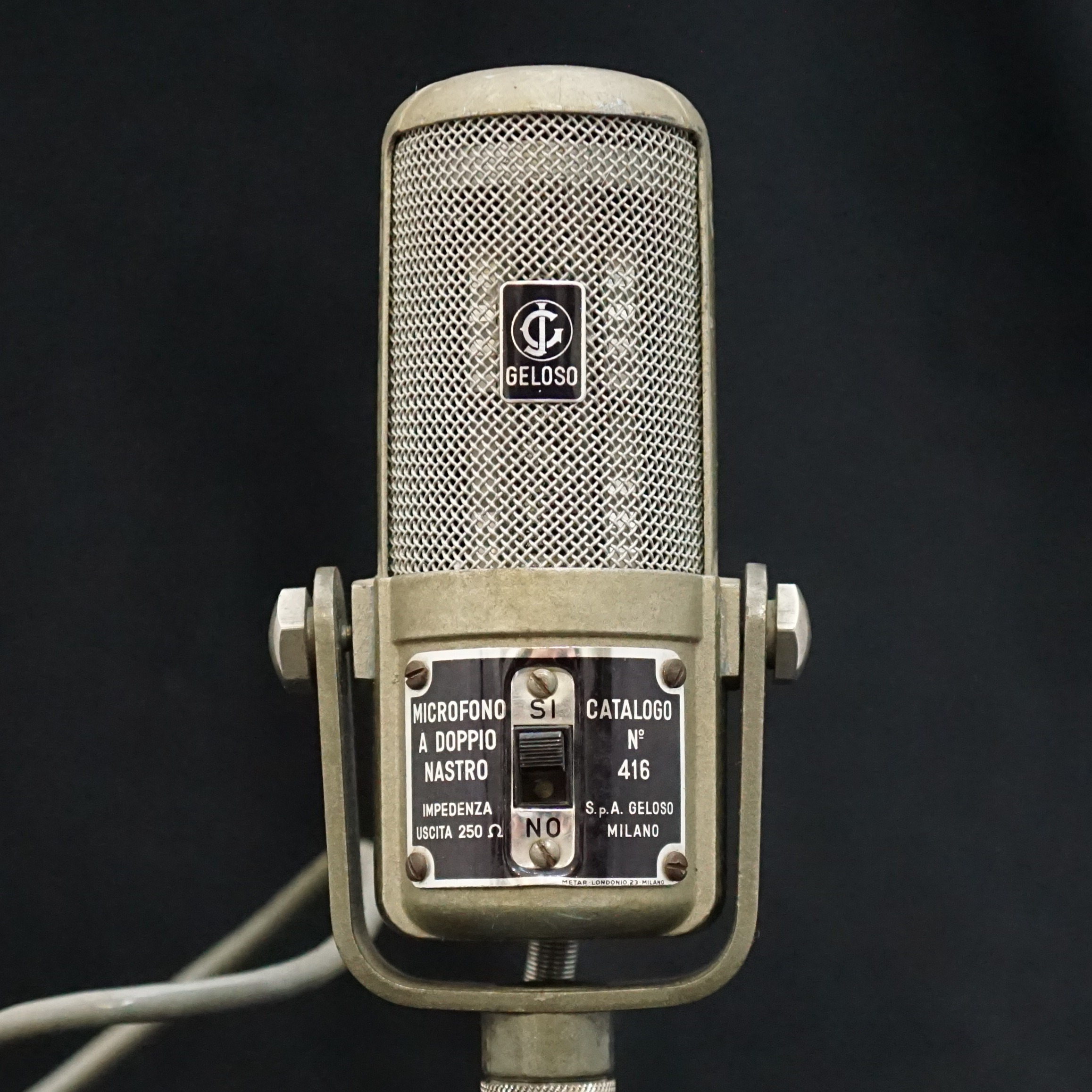
Audio Recording:
Speech (male) recorded with a Geloso 416 double ribbon microphone.
Multiple quality options available
Microphone History:
From the Geloso Bulletin, 1951.
"The "Geloso" double ribbon microphone was designed and built for use in sound systems where high fidelity is of the utmost importance. The mechanical and electrical characteristics of the microphones in this series make them the best products of their kind that can be produced.
The Geloso double ribbon microphone is presented in two basic versions: with and without a switch. Both of these models can be tabletop or floor-mounted. In the latter case, a specially designed, large-base stem allows the pitch to be adjusted from 95 to 15 degrees cw without the aid of rings or other locking systems, but solely by means of a simple and unique friction system (patented).
The microphone head is mounted on a stand that allows its inclination to be varied according to the needs or tastes of the broadcaster. Each microphone is equipped with 3.75 m of shielded cable; with the use of extension cable this length can be reached, thus allowing the microphone to be placed at a fairly considerable distance from the amplifier. If greater distances are needed, the technician can use either multiple extension cables or our rolls of cable No. 380."
MoMics View
Having owned and worked on a few of these, I would say that the 'official' description given by the Geloso marketing team at the time is being liberal with the truth. These mics are noisy and sound weird. The two thick heavy ribbons are placed side by side and give a slightly phasey sound when used off-axis, and the signal to noise is poor. This is partly due to the inefficient magnetic design - the magnetic field is forced through multiple tight right-angles, and partly due to the clamping system which runs screws through the ribbon itself. The transformer isn't great either. Despite those problems, I give them marks for innovation, and nobody else made anything quite like it. They could be used when you are looking for a unique tone on a louder sound source, but this is not a microphone for hi-fidelity acoustic recordings.
The thread on the base of the microphone appears to be a rather obscure M14 0.75 mm pitch.
Technical Description:
From the Geloso Bulletin, 1951.
"These microphones are of the double ribbon type, which has allowed for a significant reduction in size. Two ribbons are connected in series, thus increasing the output voltage. The magnetic circuit has been designed to ensure the maximum flux is transferred.*
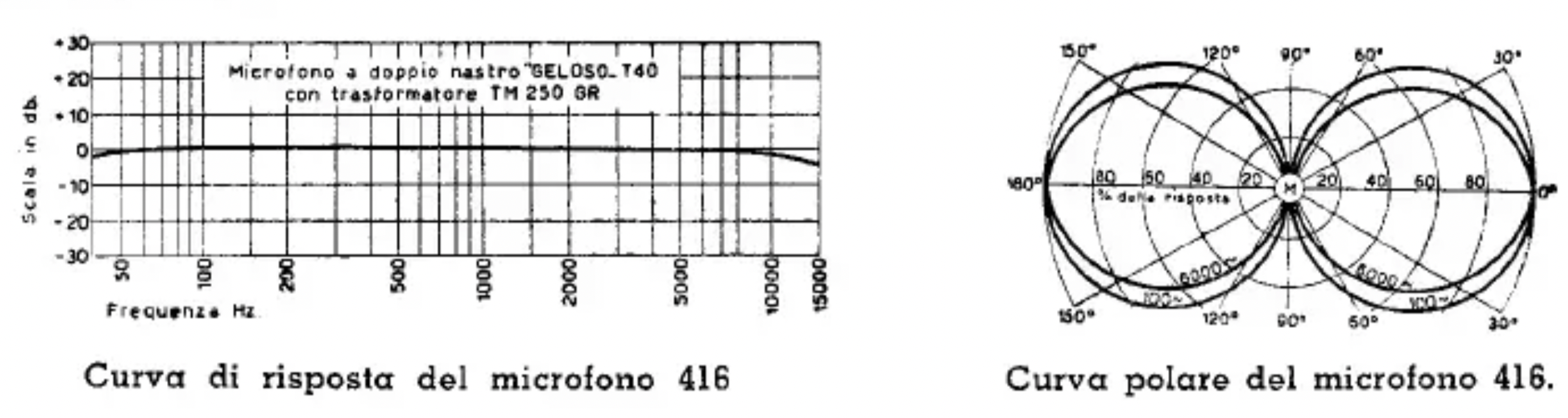
The unit is mechanically compact and structurally simple, guaranteeing maximum efficiency. The response characteristic is linear within 2 dB from 30 to 13,000 Hz (see figure). The response as a function of the polar curve of sound incidence is given in Fig. 4 (polar curve). The wide response range ensures the microphone's high fidelity.
The polar characteristic facilitates, in many cases, positioning the microphone relative to the speaker (thus reducing the Larsen effect in highly reverberant environments). The electrical waveform is linear in relation to the acoustic waveform, so no distortion or harmonics are introduced."
Frequency response plot measured by MoMics:
Frequency Response:
Impulse Response File:
Impulse Response file of the Geloso 416 double ribbon microphone.
Geloso_Double_Ribbon_IR.wav