Bruno Velotron
Manufacturer:
BrunoModel:
VelotronCountry of Manufacture:
United StatesItalyMicrophone Type:
OtherPolar Pattern:
OtherProduction Start Year:
1936Rarity:
4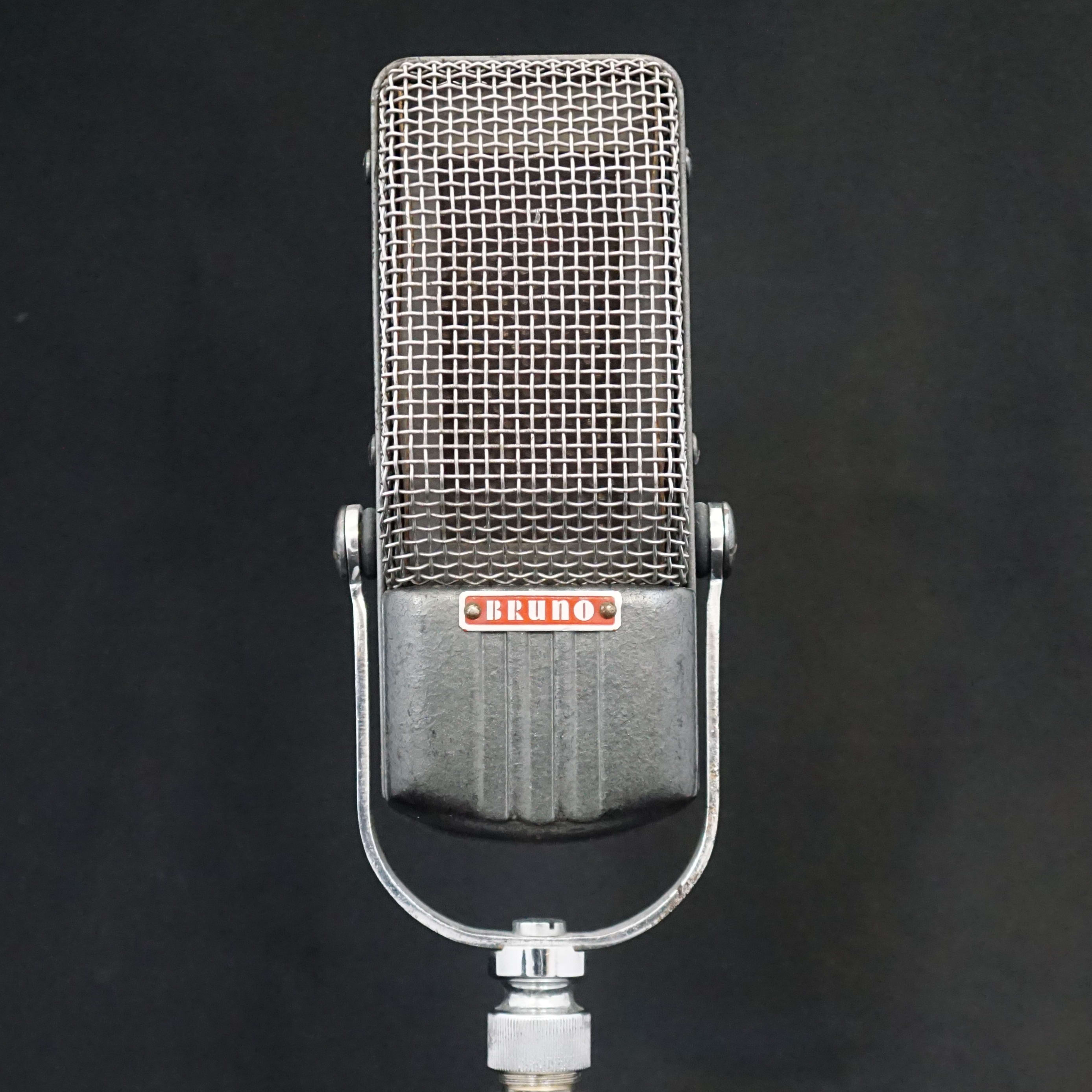
Audio Recording:
Speech (male) recorded with the Bruno Velotron microphone.*
Multiple quality options available
Microphone History:
*The recording posted above was made using a high impedance Fet amplifier similar to the circuit of a Neumann KM84, with ~45V polarisation. A higher voltage would give greater output, but also risks breaking through the elderly insulation.
MoMics historical note:
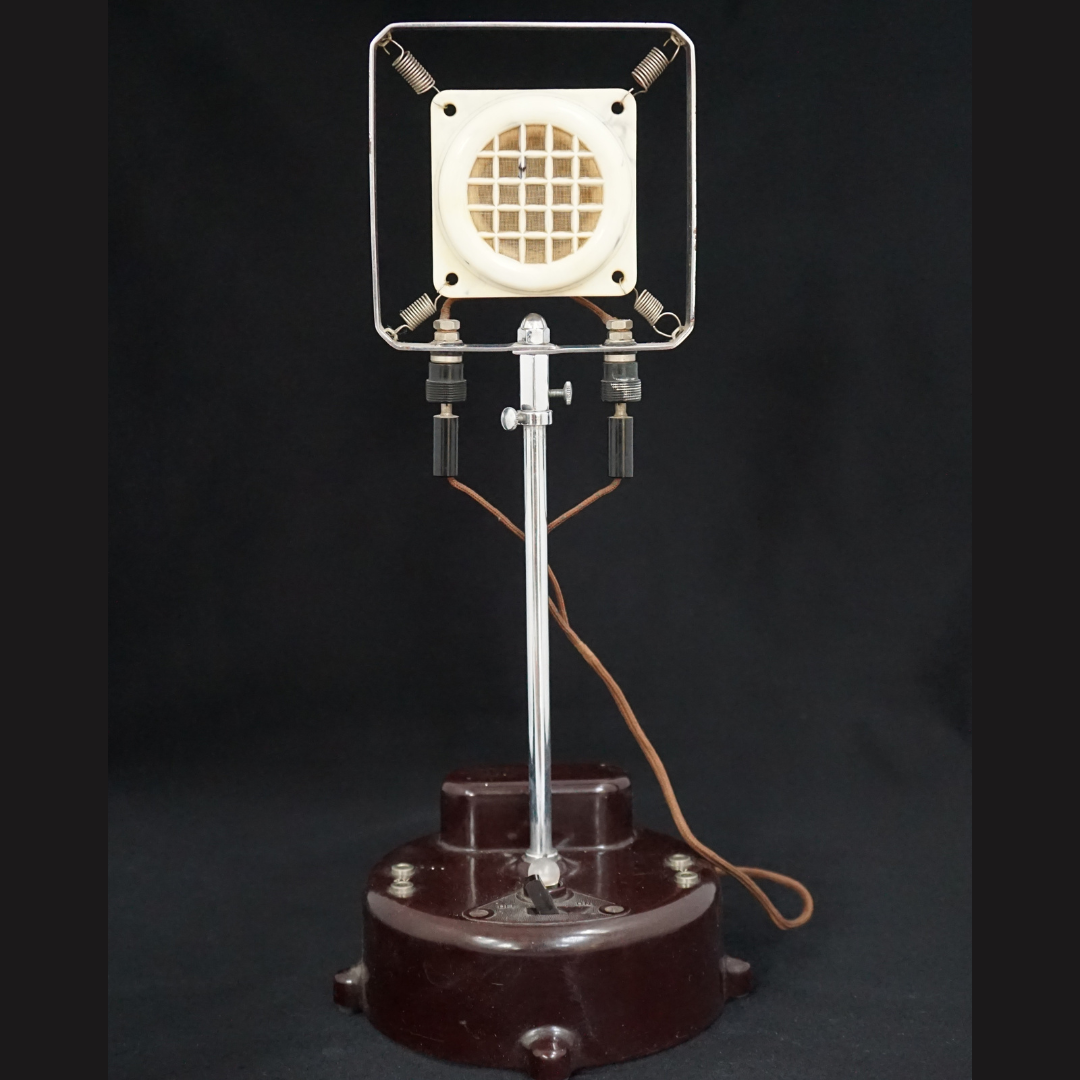
The Bruno Velotron (made by and sometimes badged as Webster) was an oddball microphone that took inspiration from both ribbon and condenser technology. Strips of aluminium foil were attached to an insulated metal backplate, and a voltage applied between the two. As the foil vibrates, the capacitance of the device varies, and a signal is generated. They are notoriously fragile, and there are very few around in working condition. One astonishing thing to note is that the earliest version of the Velotron required a polarisation voltage of between 50 and 350 volts - the latter would undoubtedly give the user an unpleasant surprise if connected in the wrong way! However, by 1939, Webster was offering a version with 'permanent polarisation' which could be used with any high impedance microphone input.
The following is from an advertisement shown is from the Radio Masters' Handbook of 1939:
"WEBSTER-CHICAGO MODEL 1240-A is a bi directional high impedance capacity device and its actuation is similar to the typical velocity microphones. In construction a residual charge is built on the dielectric, thus eliminating the necessity for a polarising potential. The output level of this microphone is relatively high and it can be used on cable lengths up to 1000 ft. The frequency characteristic is remarkably flat thus insuring natural reproduction. MODEL 1240-A as described. .....Price $22.50"
These were sold in Europe under the Radio Marelli and Industria Radiotechnica Italiana brands.
Technical Description:
From Radio Amateurs Handbook, 14th edition 1936.
THE Bruno "VELOTRON": A High Fidelity Velocity Microphone
The "VELOTRON" is more than "just another mike" ... it embodies in a simple and rugged device all the qualities of the various types, eliminating most of their defects and thus becoming the ideal microphone for the amateur and P.A, fields. Based on a new construction principle, the "Velotron" retains the high fidelity of the Velocity Dynamic microphone, surpasses the output of former, the "Velotron" will not pick-up stray r.f. currents, thus obtaining hum-less operation. It is ideally suited for outdoor transmission.
The unique design of this ultra-modern microphone makes high-fidelity operation over the entire frequency range a possibility. Frequency characteristics can also be changed to meet varying operating conditions by altering the polarising voltage. The "Velotron" may be quickly connected to the amplifier by means of a simple adapter circuit consisting of two small resistors and condensers. A diagram illustrating the necessary circuit is furnished with each microphone.
SPECIFICATIONS
Output level: -50 db.
Size: 6 x 2.25 x 1.5 inches. Weight: 1 lb.
Output impedance: to grid
Frequency response: 30 to 14,000 Hz (adjustable)
Finish: Gunmetal
Polarisation voltage: 150 to 350 volts
LIST PRICE: $19.50
----
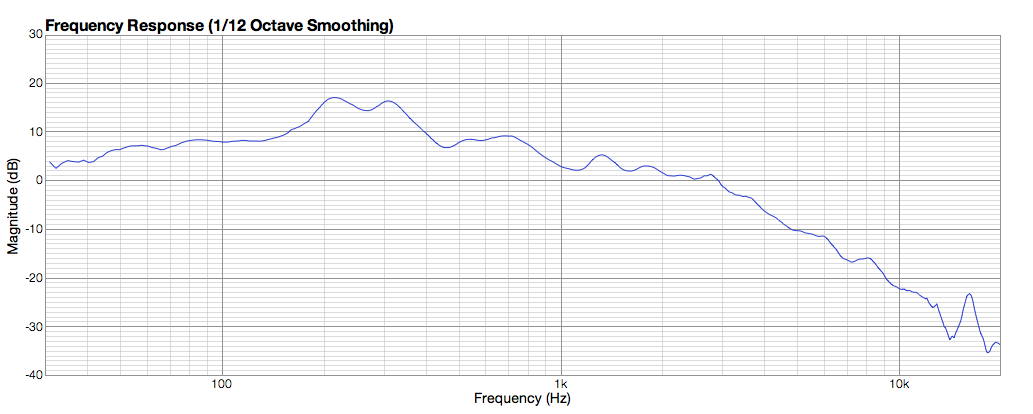
Frequency Response:
Further Reading:
The Velotron microphone and how it works is discussed in detail in Electronics Magazine, September 1936. This includes internal photographs and a circuit for supplying the required polarisation voltage to the microphone.
About the Bruno & Webster Velotron mics at the Coutant Website.
A technical discussion and attempted repair of the Bruno Velotron at the Xaudia microphone blog.