Steeg & Reuter Crystal
Manufacturer:
Steeg & ReuterModel:
CrystalCountry of Manufacture:
GermanyMicrophone Type:
PiezoelectricPolar Pattern:
OmnidirectionalProduction Start Year:
1950Rarity:
5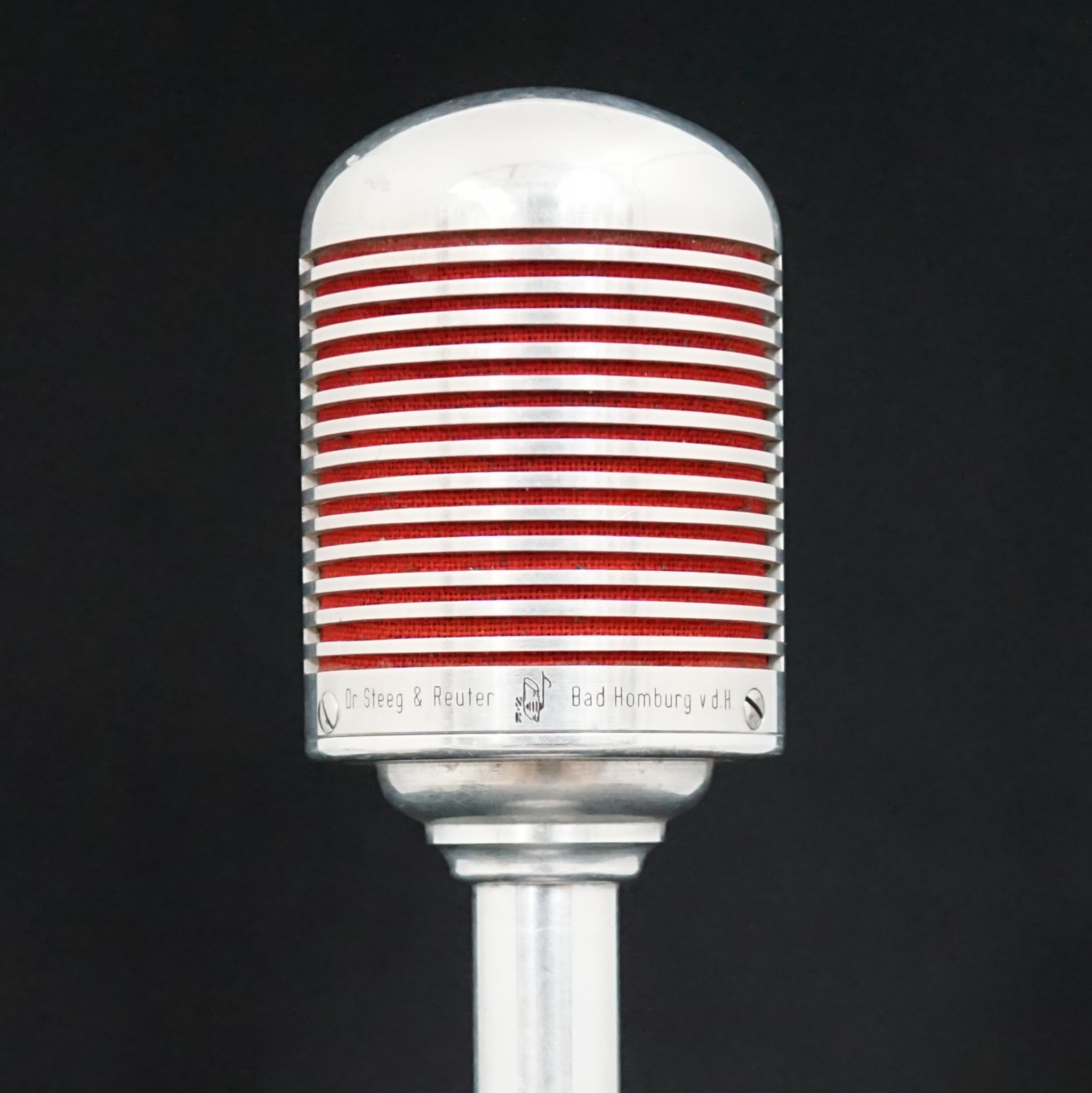
Audio Recording:
Speech (male) recorded with the Dr. Steeg & Reuter crystal microphone.
Multiple quality options available
Microphone History:
The company was founded by in 1855 by Wilhelm Steeg, who was joined by Peter Reuter as a co-owner in 1877. Steeg & Reuter focused mainly on optical devices and had some expertise in growing crystals, which was also of relevance to microphone technology. The company formerly known as Steeg & Reuter continue to the present day as S&R Optics GmbH.
The Steeg & Reuter factory was inspected and possibly commandeered by allied forces shortly after the Second World War. A report was published by the slightly sinister sounding British "Combined Intelligence Objectives Sub Committee in June of 1945. This report mentions microphones only in tangent:
"During the war the production of laboratory equipment has been suspended and the main activity of the firm has been the production of 6000 quartz crystals per month and 10,000 Rochelle salt crystals per month. The former have been for frequency control circuits from 50 Hz upwards and the shortage of good quartz has led to the development of methods for the most economical use of the material available, both as regards the cutting of the maximum number of crystals from a given raw crystal, as regards the design of crystals and holders to economise in the use of raw material.
The Rochelle salt crystals have been supplies for incorporation in crystal pick ups and microphones.
Ninety per cent of the output of the firm was delivered to Telefunken and other customers supplied were Lerde, Loewe, Huth, Korting and Lorenz. Complete card index of the customers to whom deliveries have been made is maintained intact and might be worth a detailed study."
Technical Description:
MoMics note.
This high impedance piezoelectric crystal microphone takes the form of an elegantly domed, polished aluminium cylinder with narrow horizontal slots on once side only, which presumably confers some degree of directionality to the device. The capsule housing is mounted on a long thin handle, giving it the overall appearance of a Stielhandgranate or stick grenade. Connection to an amplifier is made via a removable bayonet-style plug with a threaded base that can be attached to a microphone stand if required. The sound is much as one would expect.
Further Reading:
A similar microphone appears in the microphone collection of Bert van Oortmarssen. Bert dates his microphone to around 1950, which seems plausible.
Funkshau magazine briefly refers to a 'Kristallmikrofonkapsel', model MMK01 in issue 12, 1951.
Two Dr. Steeg and Reuter 'pickup units for heart sounds' appear in records linked to Operation Paperclip, secret U.S. government program aiming to salvage German scientific research in to aeromedical research. Read more about Operation Paperclip here.