Grundig GCM3
Manufacturer:
GrundigModel:
GCM3Country of Manufacture:
United KingdomMicrophone Type:
CondenserPolar Pattern:
CardioidProduction Start Year:
1956Production End Year:
1965Rarity:
1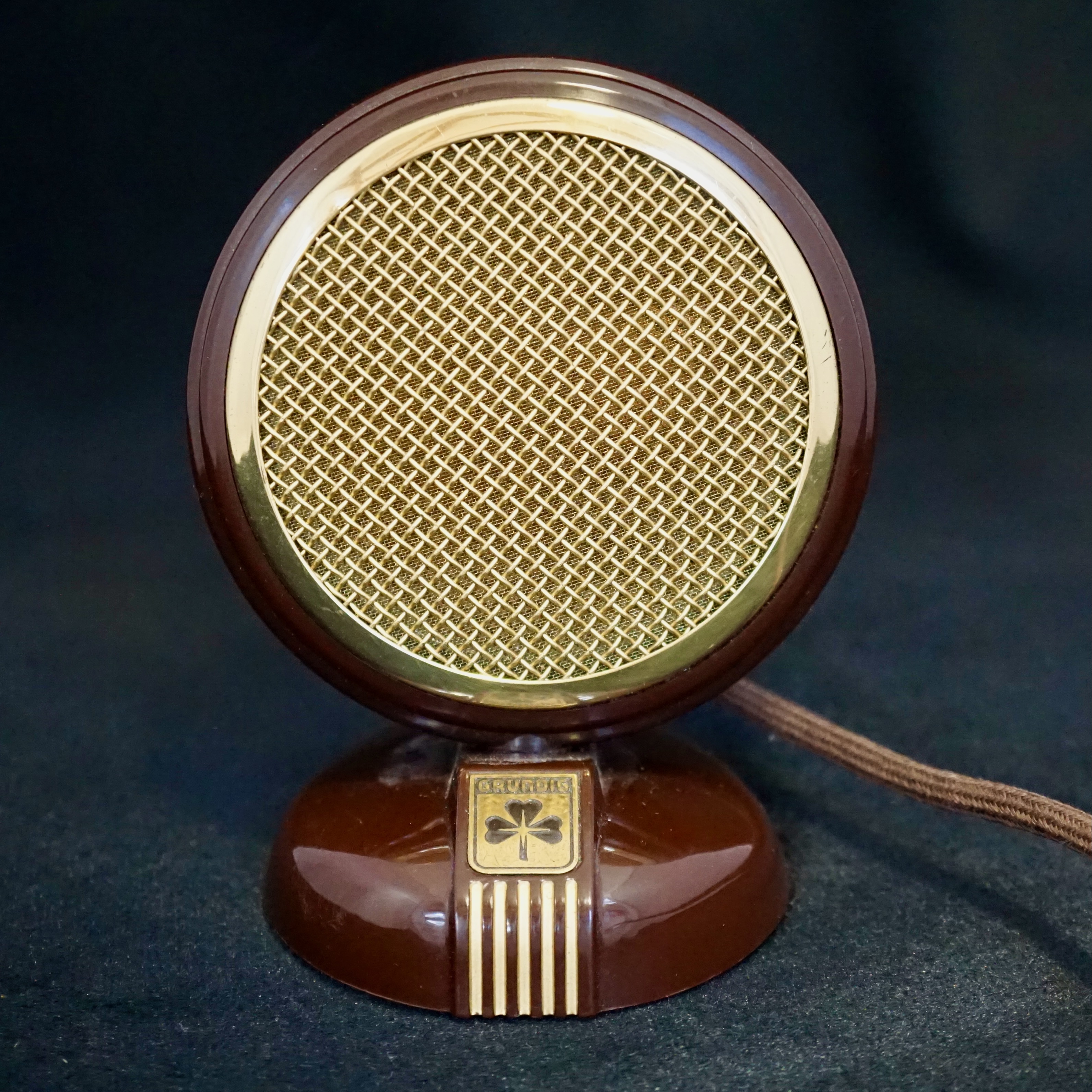
Audio Recording:
Nylon string guitar recorded with the GCM3 microphone.
Multiple quality options available
Microphone History:
From a review of a Grundig stereo tape machine (TK55) in Tape Recording Magazine, August 1959;
"I was able to test the instrument with the Grundig Condenser microphone type G.C.M.3, which can be supplied at £6 6s. This is an excellent instrument and proved its fidelity and response to a high degree when the TK55 was used in a train recording session on the British Railways, Eastern Section, main line. Really excellent recordings were obtained with plenty of bass and transient response so necessary for good reproduction of "train sounds," and which were very evident on playback."
Technical Description:
Momics view
The Grunding GCM3 is essentially a very large diaphragm condenser microphone capsule in a plastic (not bakelite) case. The capsule is around 3 inches / 7.5 cm across which makes it the largest we have seen. GCM3 microphones were either brown and gold or blue and grey.
The GCM3 was designed to work only with Grundig tape recorders and so lacks an internal amplifier circuit. It must be connect to a very specific circuit that was built which supplies approximately 100V polarisation across the capsule at very low current.
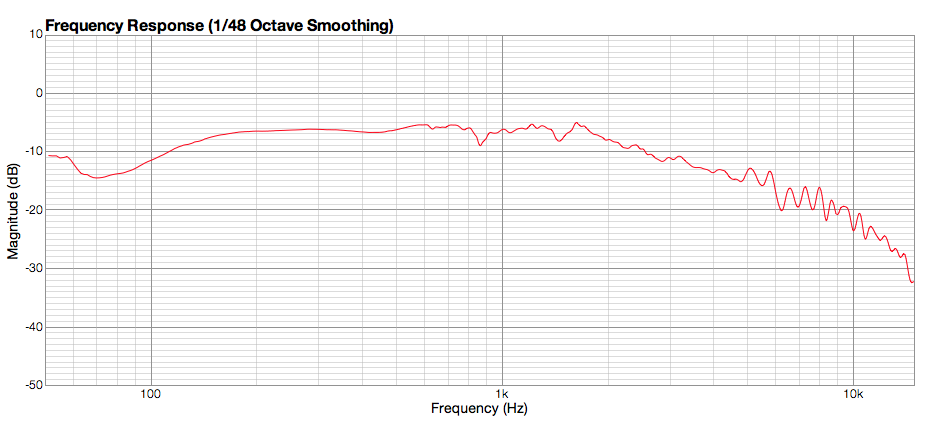
For the sound recordings and measurements here we built a simplified circuit based on a Neumann KM84, which runs on standard phantom power, and simply connected the GCM3 as the capsule. The circuit only provides 48V polarisation, which would give a reduction of around 6 dB of signal. However, the output is still strong with a good signal to noise.
We have seen some examples of this microphone with slack or split diaphragms, and cable capacitance may also be a problem.
Frequency Response:
Impulse Response File:
Impulse Response file of the Grundig GCM3 microphone.
Grundig_GCM3_IR.aiff