Grundig GBM125
Manufacturer:
GrundigModel:
GBM125Country of Manufacture:
GermanyMicrophone Type:
RibbonPolar Pattern:
CardioidProduction Start Year:
1959Production End Year:
1965Rarity:
4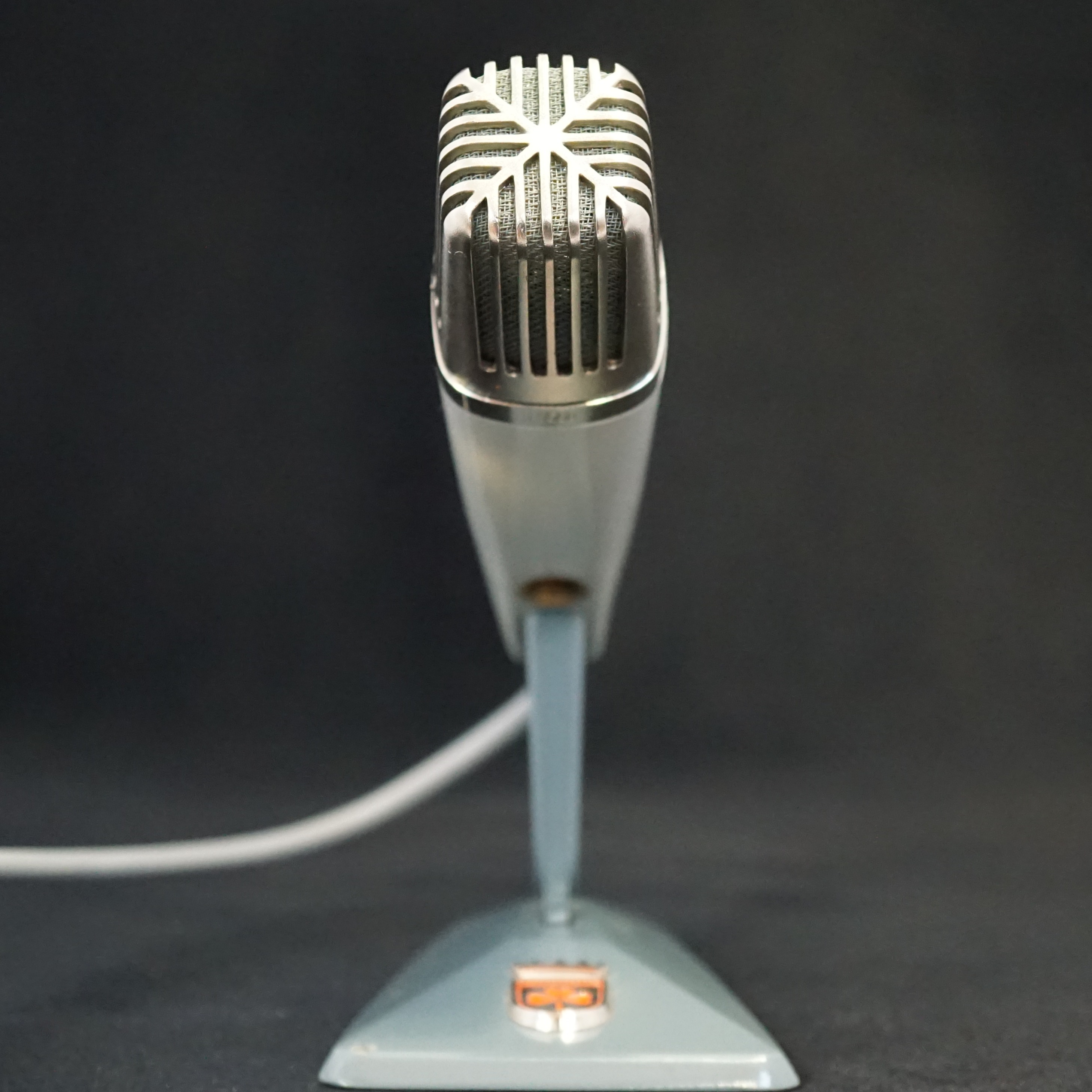
Audio Recordings:
Nylon string guitar recorded with the Grundig GBM125 ribbon microphone.
Multiple quality options available
Speech (male) recorded with the Grundig GBM125 ribbon microphone.
Multiple quality options available
Technical Description:
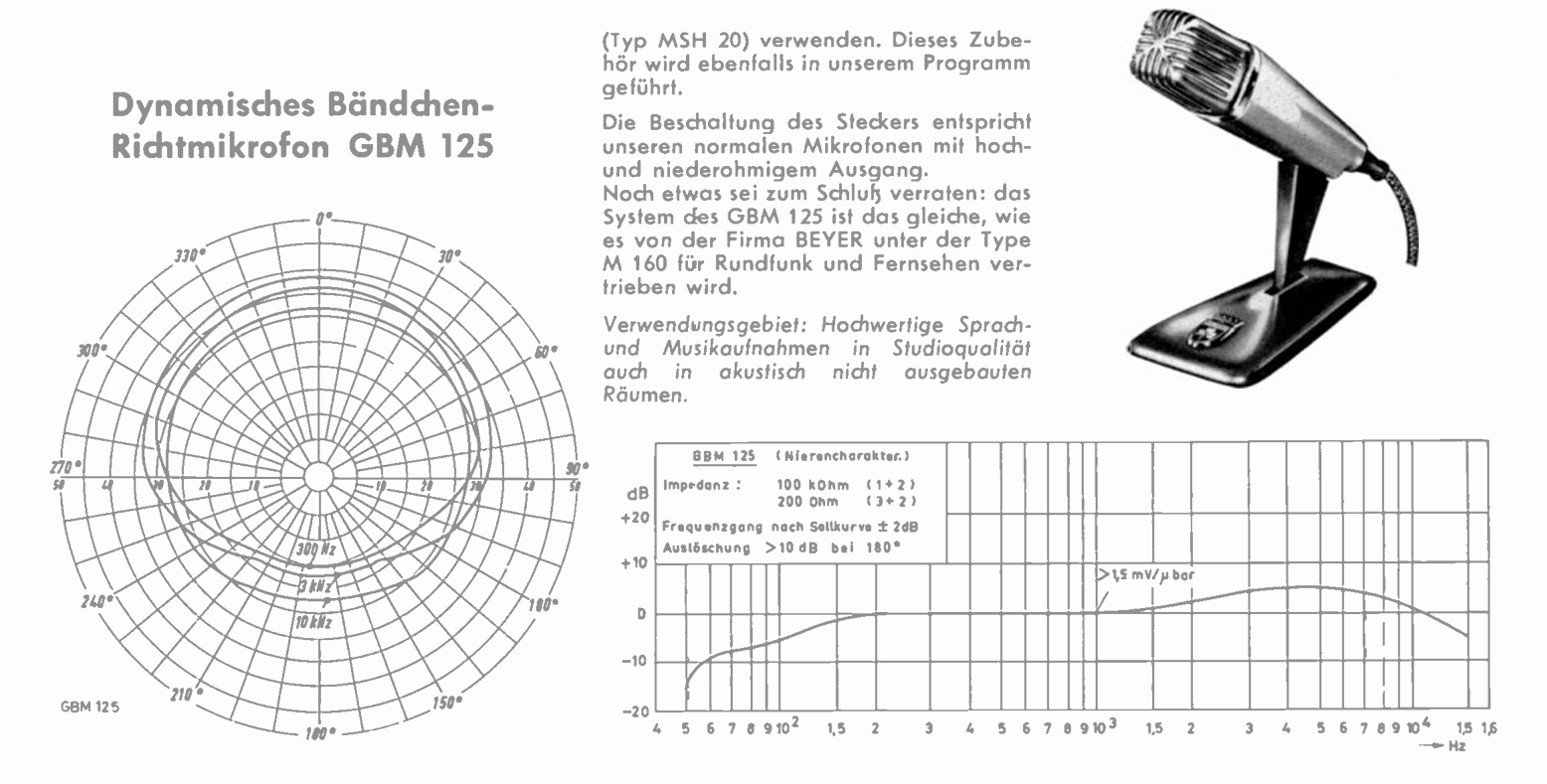
Taken from a 1959 Grundig technical information booklet (see page 25):
The microphones mentioned so far all operate on the dynamic principle, meaning a small coil centered by the diaphragm moves within the field of a permanent magnet. These microphones are therefore also called moving-coil microphones. The diaphragm is attached to the coil. The construction thus corresponds exactly to that of permanent-dynamic loudspeakers. The GBM 125 ribbon microphone operates on the same physical principle, i.e., with a conductor loop moving within a magnetic field. However, the coil of the moving-coil microphone is shrunk down to a thin aluminum ribbon. This ribbon serves simultaneously as an induction loop and as a diaphragm. As can easily be seen, the moving masses in the ribbon microphone are significantly smaller than in the moving-coil microphone. Resonance phenomena, which are unavoidable in a simple moving-coil microphone, hardly occur in the ribbon microphone, and transient responses are also below the threshold of audibility.
The frequency response of the GBM 125 is balanced and covers the entire usable audio frequency range. However, the main advantage of the GBM 125 ribbon microphone lies in its true cardioid polar pattern, which is consistent across the entire frequency range. The difference is clearly visible in the polar diagrams of the GDM 16 and GBM 125. The directional characteristic of the GDM 16 is strongly frequency-dependent. For recording, this means that instruments playing in the region of rear attenuation are not reproduced quite as faithfully as the GBM 125. The tonal character of these instruments is therefore slightly blurred. This disadvantage is mitigated by the GBM 125's attenuation of approximately 20 dB. This high attenuation allows for very effective suppression of room reflections and background noise. Recordings with the GBM 125 sound clear and transparent. The uniformity of the transmission characteristics allows for the advantageous use of two GBM 125 microphones in stereo recording.
The GBM 125 microphone is a sleek plastic housing made of impact-resistant polystyrene with a built-in metal basket. A table stand, which slides into a groove on the underside of the housing, is also included. Naturally, the GBM 125 has a tripod thread. After removing the stand, a tripod (e.g., 5" x 15") can be screwed in. Due to its pronounced directional characteristics, the GBM 125 requires precise aiming at the speaker or instrument. A short gooseneck is advantageous for this purpose.
Frequency Response: