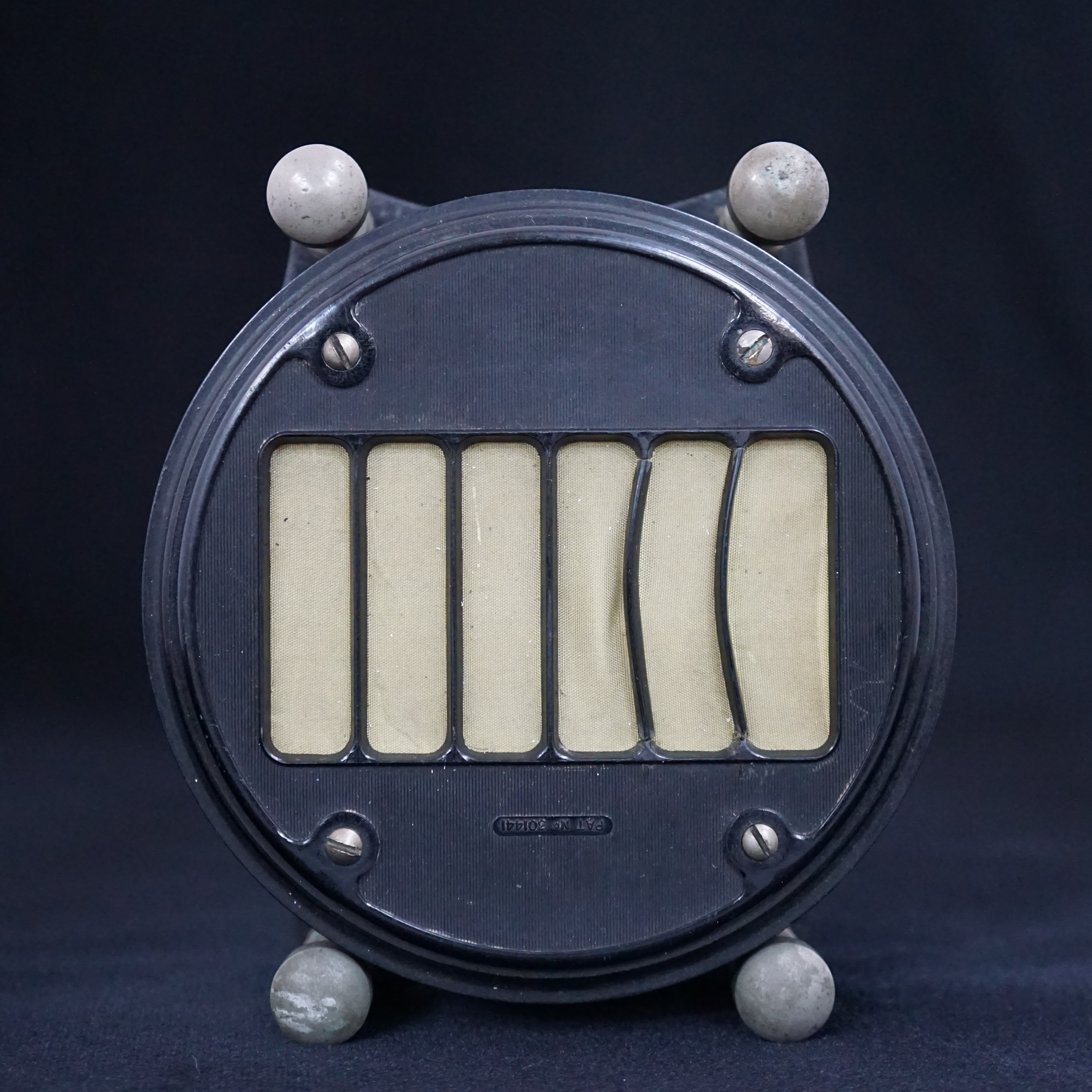
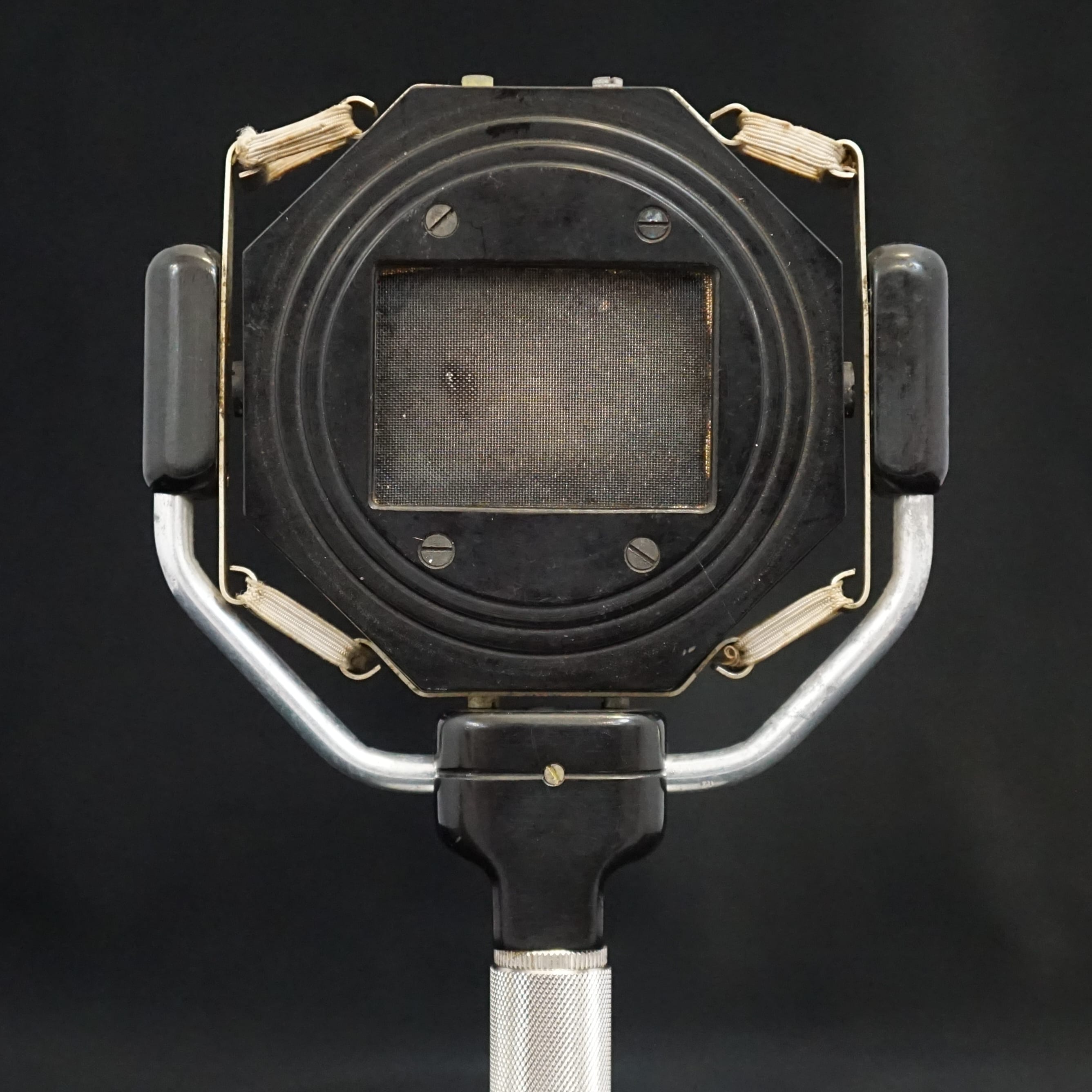
Bell "Gallows" Transmitter
Manufacturer:
BellModel:
"Gallows" TransmitterCountry of Manufacture:
United StatesMicrophone Type:
DynamicPolar Pattern:
CardioidProduction Start Year:
1876Production End Year:
1876Rarity:
5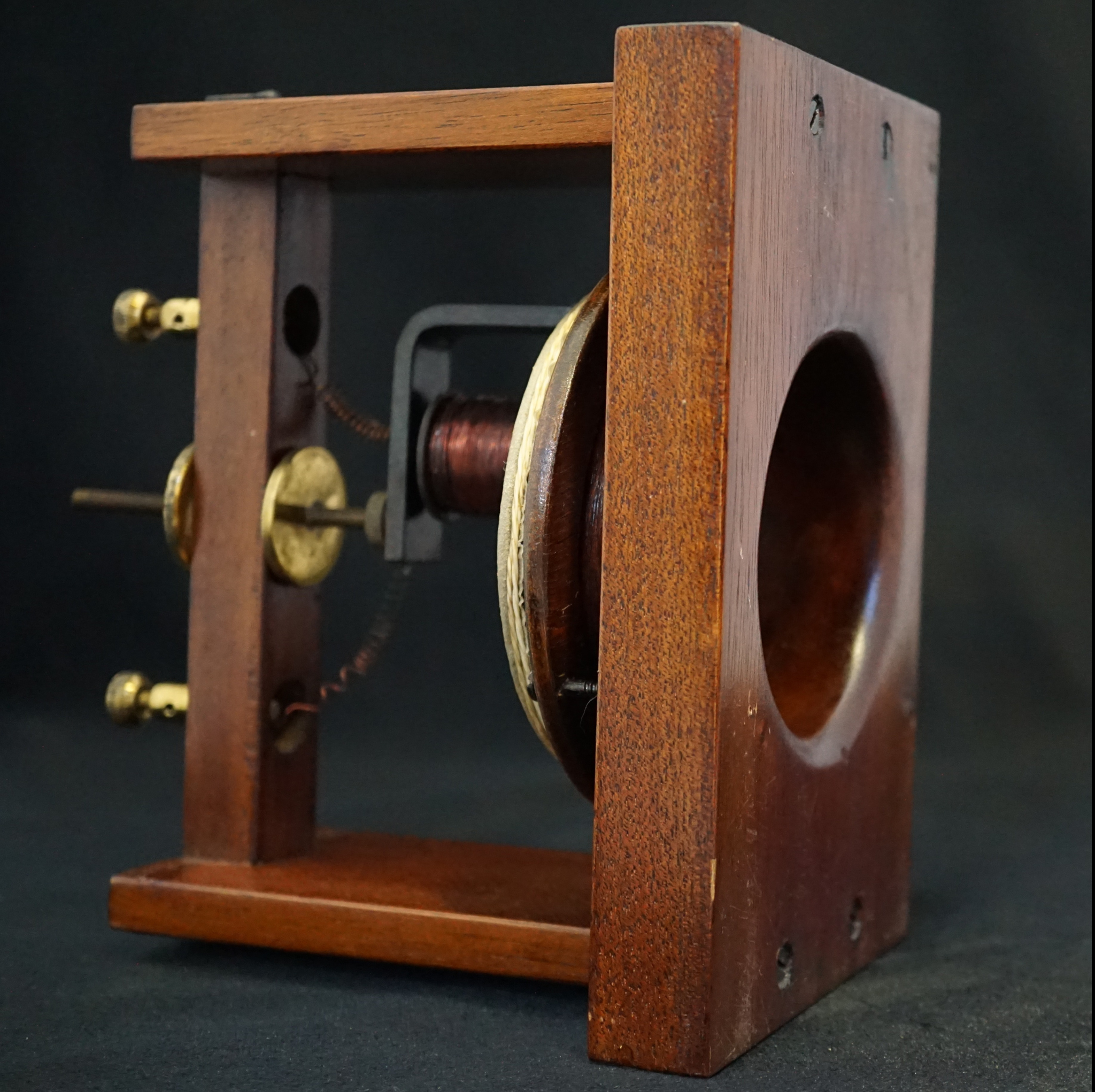
Audio Recordings:
Speech (male) recorded with the Bell Gallows microphone saying "This is the sound of the Bells Gallows microphone. It was invented in 1876 and is the oldest microphone in our collection. It uses a drum skin, and a cork, and a little coil of wire..."
Multiple quality options available
Speech (male) recorded with the Bell Gallows microphone fitted with a new skin and a 0.4 mm gap between the magnet and the coil. The voice says "We're calling New York on the telephone. Can you hear me?"
Multiple quality options available
Speech (male) recorded with the Bell Gallows microphone fitted with a new skin and a 0.2 mm gap between the magnet and the coil. "This is the sound of the Bells Gallows telephone. This was the first telephone transmitter...,"
Multiple quality options available
Speech (male) recorded with the Bell Gallows microphone fitted with a new skin and a 0.4 mm gap. Higher supply voltage. The voice says "This is the Bells Gallows Transmitter... Test....Sounds... Plosive"
Multiple quality options available
Microphone History:
This is an exact replica of Alexander Graham Bell's first telephone microphone, which was made and patented in 1876. It appears to be nearly identical to this exhibit in the British Science Museum, which was made by Charles Williams Jr. of Boston, who made Bell's original apparatus. Our example is old but and has no makers mark - a dark rectangle on the wooden frame suggests a long-lost badge or label.
The device consists of a membrane stretched tightly over a wooden hoop, a leaf spring and a coil of wire wound around a ferrous core which acts as an electromagnet and also as the receiver. The Gallows receiver operates as follows: the user speaks into the hole in the side of a wooden frame which is covered by a stretched diaphragm made of hide, much like the top of a drum. The sound waves vibrate the membrane. A piece of cork is glued to the centre of the skin which in turn moves a leaf spring closer to the coil. This movement induces an AC signal in the coil, which would drive a receiver of a similar construction. The coil and leaf spring are similar to telegraph devices of the same era - it is essentially a telegraph transmitter driven by a membrane.
By all accounts the design transmitted sound but fell short of sending intelligible speech. Although the principle is correct, all of the components seem far too massive to pick up the required nuances.
Technical Description:
From Alexander Graham Bell's US Patent no.US174465, 7 March 1876
"Another mode is shown in Fig. 7, whereby motion can be imparted to the armature by the human voice or by means of a musical instrument. The armature c, Fig. 7, is fastened loosely by one extremity to the uncovered leg d of the electro-magnet b, and its other extremity is attached to the centre of a stretched membrane, a. A cone, A is used to converge sound vibrations upon the membrane. When a sound is uttered in the cone the membrane g is set in vibration, the armature c is forced to partake of the motion, and thus electrical undulations are created upon the circuit E-b-e-f-g.
The undulatory current passing through the electro-magnet influences its armature h to copy the motion of the armature c. A similar sound to that uttered into A is then heard to proceed from L."
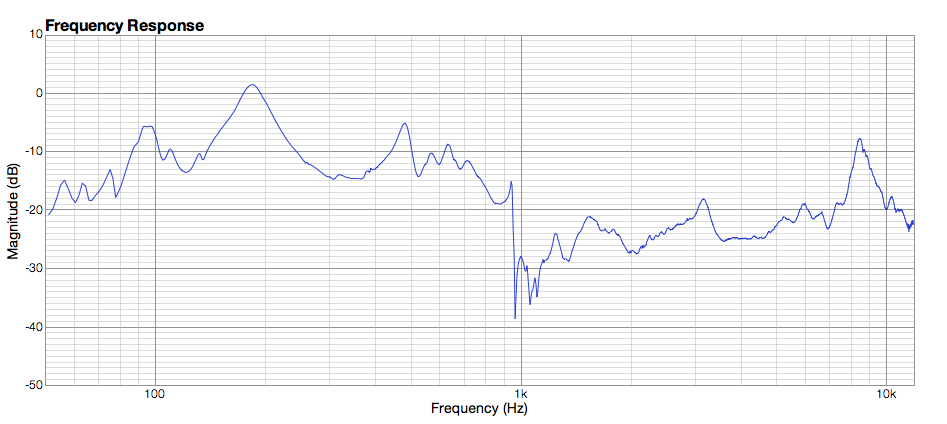
Frequency Response:
Impulse Response File:
Impulse Response file of the Bell "Gallows" transmitter.
Bells_Gallows_IR.aiff