RCA BK-5B
Manufacturer:
RCAModel:
BK-5BCountry of Manufacture:
United StatesMicrophone Type:
RibbonPolar Pattern:
CardioidProduction Start Year:
1955Production End Year:
1976Rarity:
3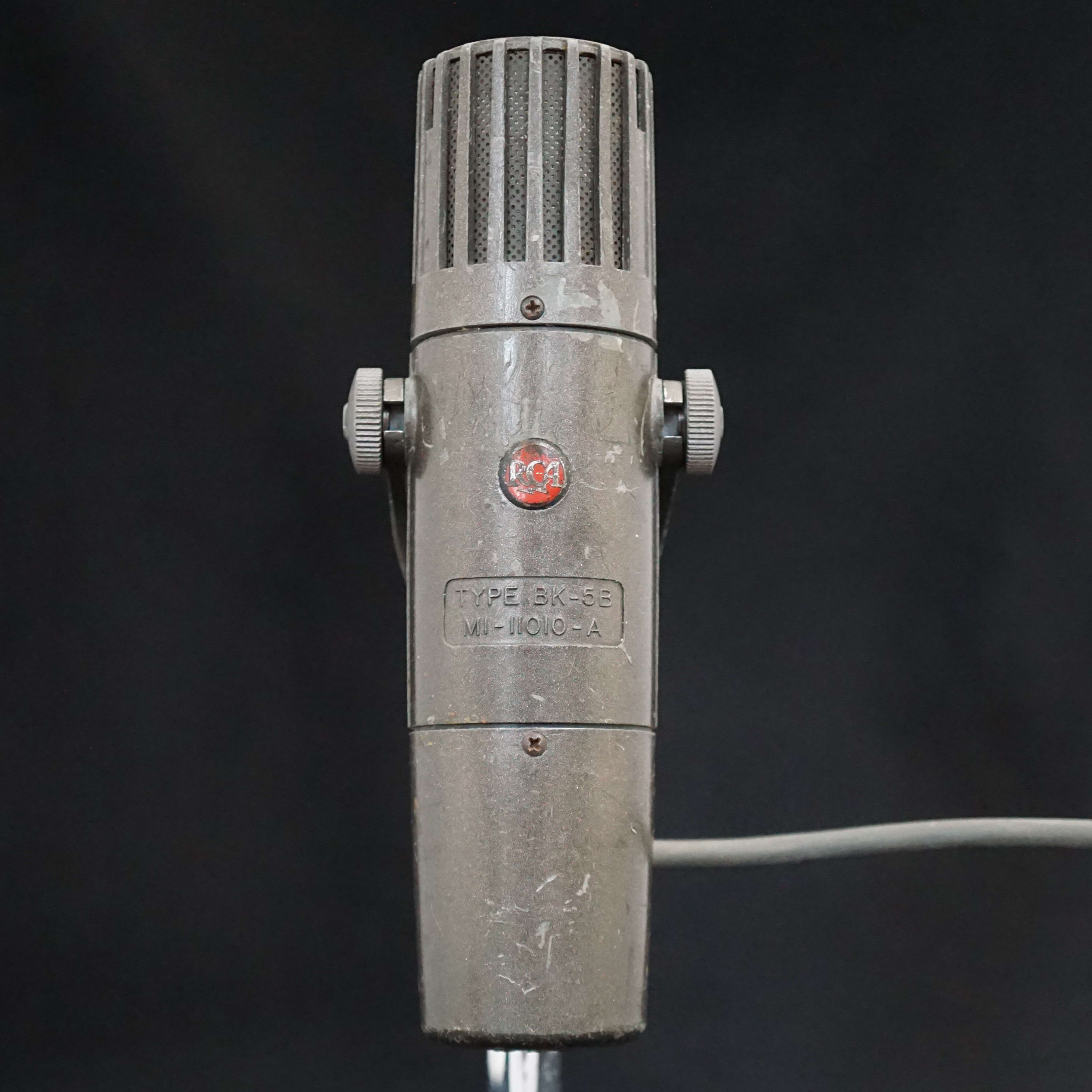
Audio Recording:
Nylon string guitar recorded with an RCA BK-5 ribbon microphone.
Multiple quality options available
Microphone History:
The RCA BK-5A and BK-5B were introduced in the early 1950s as part of RCA’s effort to provide a compact, rugged, and directional ribbon microphone suitable for broadcast, film, and television studios. At a time when large bi-directional ribbon microphones like the RCA 44 series were common, the BK-5A offered a more focused cardioid pattern optimised for studio environments where off-axis rejection, camera-friendly form factors, and the ability to withstand high-SPL environments were increasingly important.
Technical Description:
The RCA BK-5A (MI-11010) and BK-5B (MI-11010-A) are uniaxial (cardioid) ribbon microphones designed for broadcast, studio, and film applications.
The microphones use a ribbon transducer, with one side of the ribbon open to the atmosphere and the other in front of an acoustic labyrinth. This labyrinth incorporates openings that introduce controlled phase differences, improving the microphone's unidirectional characteristics and rejection of off-axis sound.
The ribbon element is protected by a double-layer blast filter, consisting of two layers of cloth supported by perforated metal screens, designed to withstand high sound pressure levels. An additional external windscreen was also available for outdoor applications.
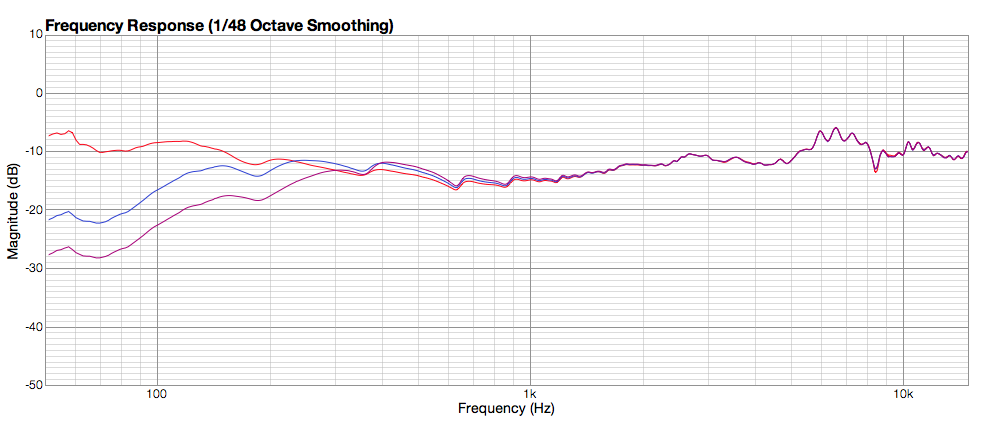
A three-position bass roll-off switch labeled M (Music), V1, and V2 allows users to tailor the microphone’s low-frequency response for different recording scenarios, aiding in proximity effect management or reducing low-end rumble.
The BK-5 series includes a shielded transformer providing a standard output impedance of 250 ohms, with options to configure for 30 or 150 ohms. The effective output level is rated at -57 dBm at 1000 Hz for a sound pressure of 10 dynes/cm²..
The frequency response for both BK-5A and BK-5B is broadly stated as 50 Hz to 15 kHz, while later RCA catalogues advertise the BK-5B frequency response as being 30 Hz to 20 kHz.
Frequency Response:
Impulse Response Files:
Impulse Response file of the RCA BK-5B ribbon microphone in position M
RCA_BK5_M_IR.wav
Impulse Response file of the RCA BK-5B ribbon microphone in position V1
RCA_BK5_V1_IR.wav
Impulse Response file of the RCA BK-5B ribbon microphone in position V2
RCA_BK5_V2_IR.wav
Further Reading:
RCA BK-5A Instructions and specification available at:
https://www.worldradiohistory.com/Archive-Catalogs/RCA/Mics/RCA-BK-5A-MI-1954.pdf
RCA BK-5B technical description and specification available at:
(pg.8/pg.9): /https://thehistoryofrecording.com/Literature/RCA/RCA-Broadcast-Equipment-Catalog-1962-5th-Edition.pdf
(p.10/P.11): https://thehistoryofrecording.com/Literature/RCA/RCA-Broadcast-Equipment-Catalog-1968.pdf
Further Reading:
Contempory review of BK-5A that suggests a difference in the air vent behind ribbon of BK-5A / BK-5B models: https://tapeop.com/reviews/gear/65/bk-5a-vintage-ribbon-mic