RCA Photophone MI-3027-E
Manufacturer:
RCA PhotophoneModel:
MI-3027-ECountry of Manufacture:
United StatesMicrophone Type:
RibbonPolar Pattern:
Figure 8Production Start Year:
1936Rarity:
4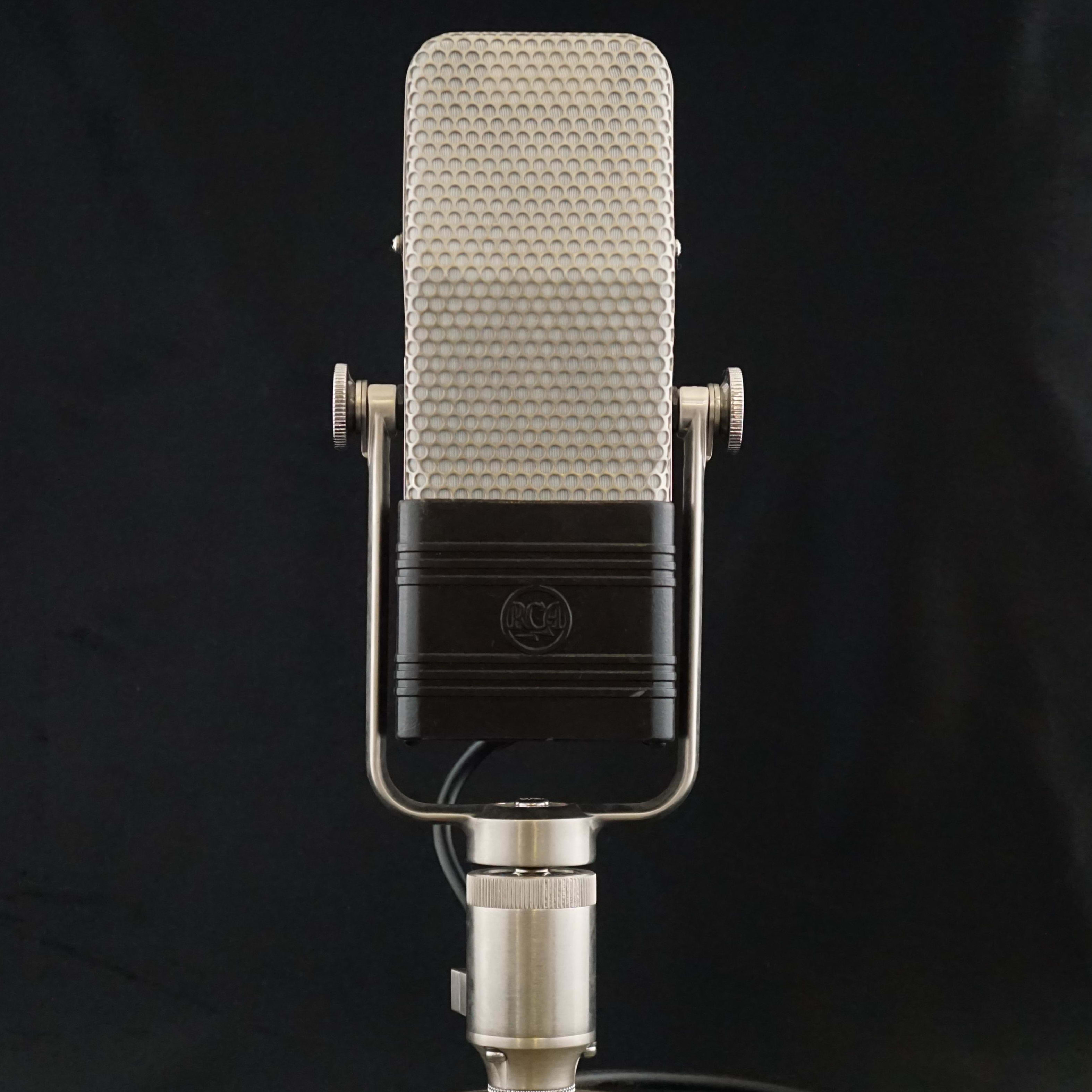
Microphone History:
MoMics View
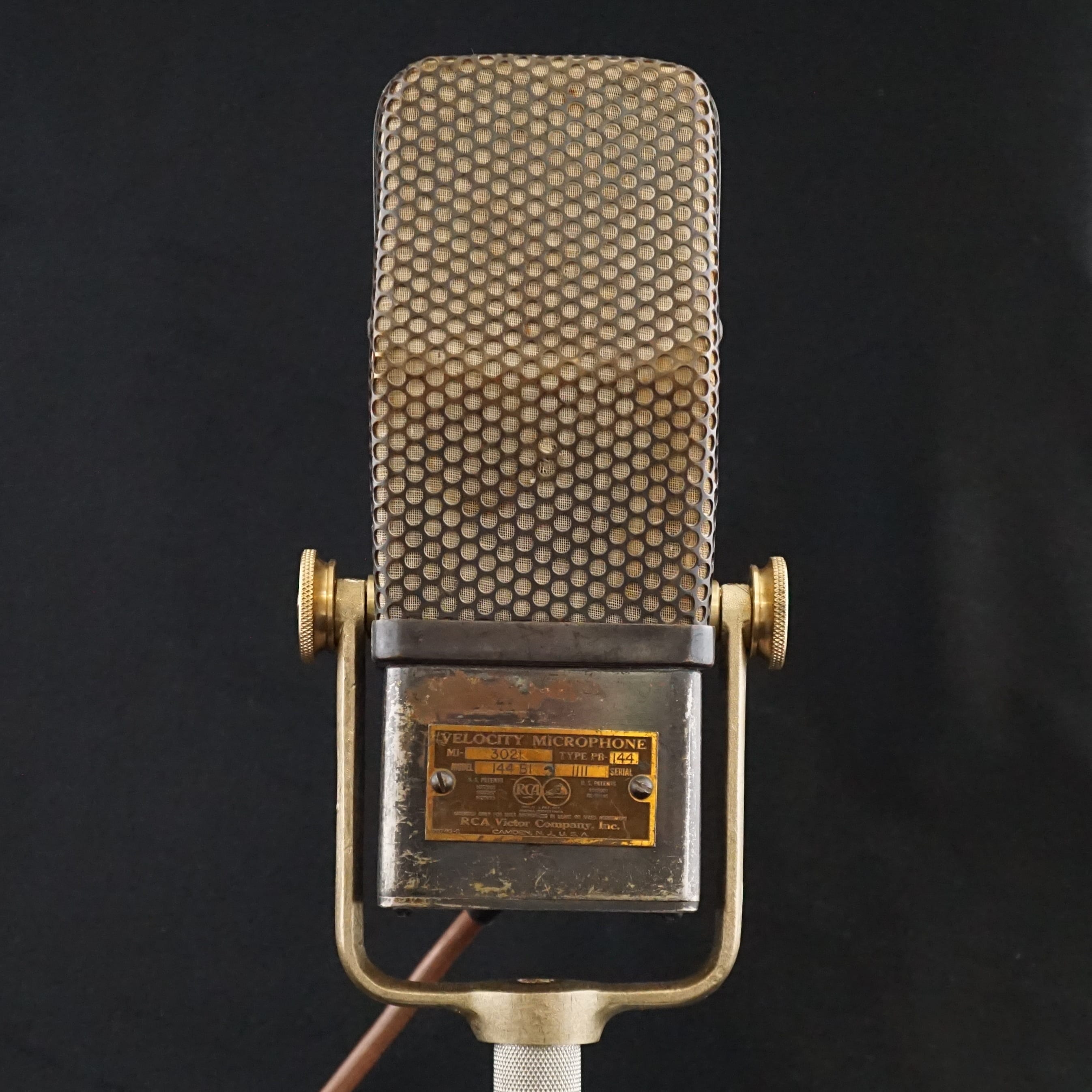
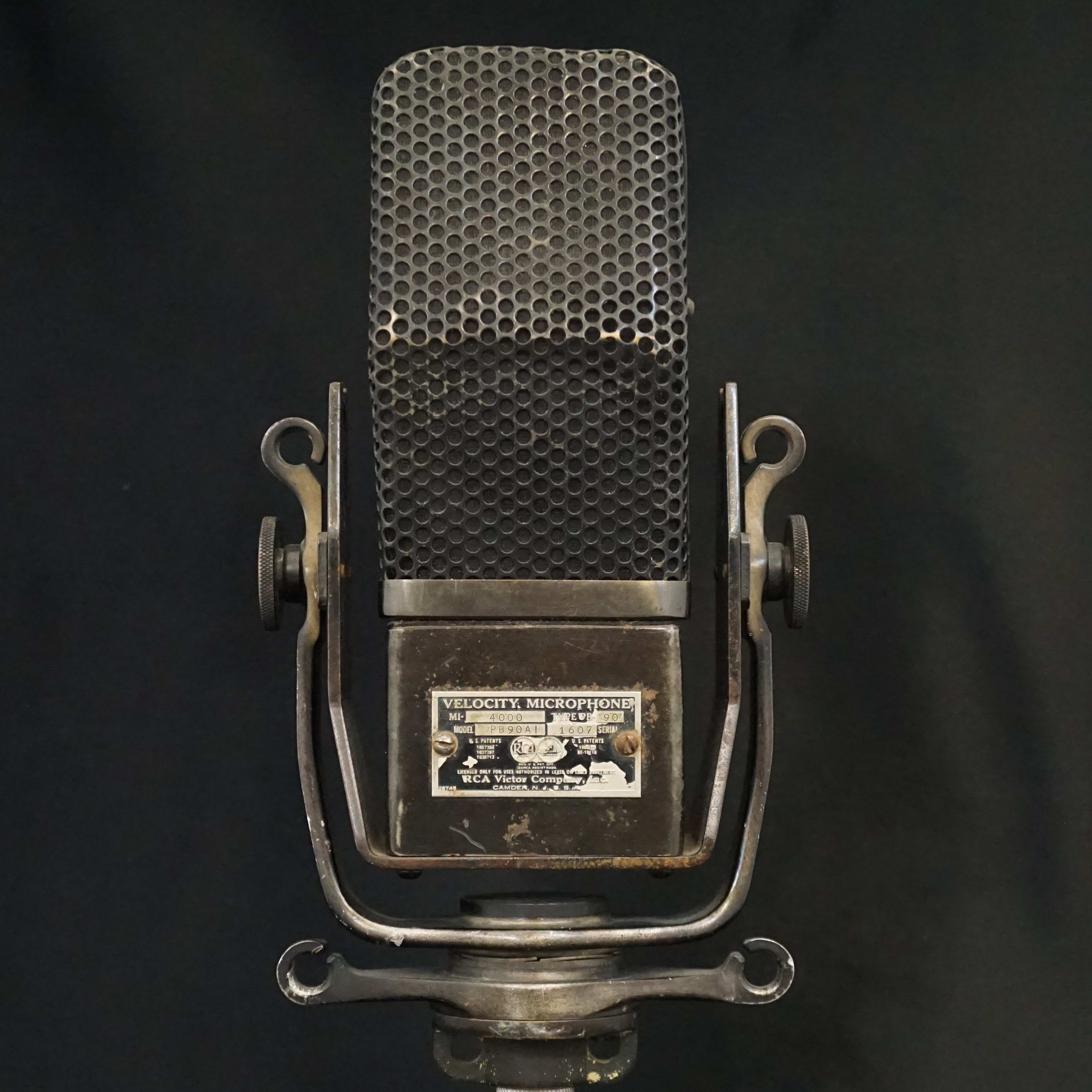
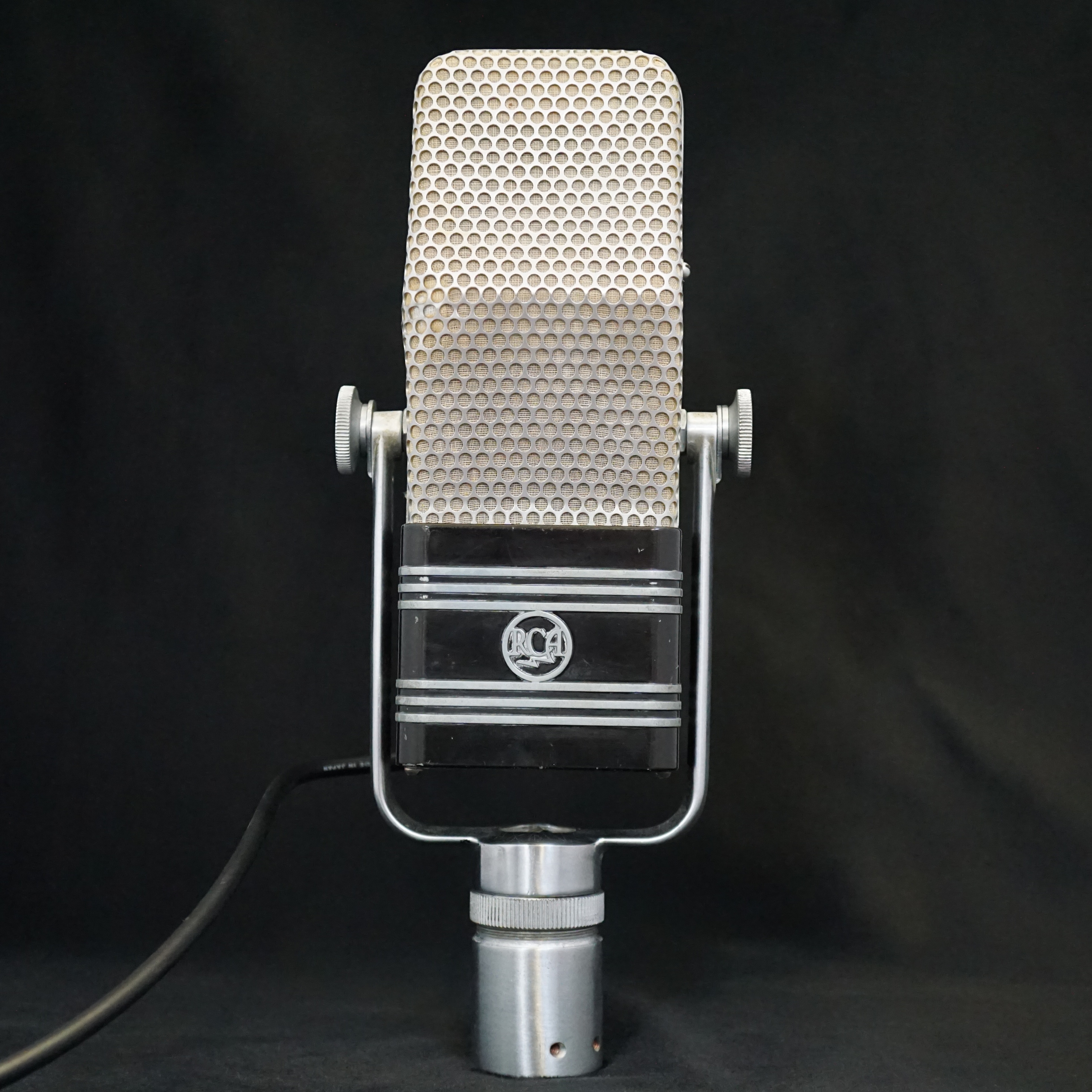
The MI-3027 is the RCA-Photophone version of the RCA 44B, and as far as we can tell was introduced in 1936. This microphone does not appear in any of the RCA catalogues but the instructions are dated 1936. Photophone branded microphones were made for the movie industry and the earliest mics had a a dark finish so as not to reflect light on a film set.
The MI-3027 in our collection has the suffix E and this appears to be nearly identical to the 44BX, and has been repaired and updated using replica grills and yoke from AEA. At a glance one would guess this is a 44B or BX, and the only real way to know the model number is to look for a stamp or label inside the microphone.
Technical Description:
From the RCA Photophone MI-3027 manual
1. INTRODUCTION - The velocity microphone is this result of several years of intensive research and development toward the improvement of the characteristics of microphones as used for recording purposes, and is entirely different in principle and construction from other microphones now in use. Instead of a "diaphragm" (in the commonly accepted meaning of this word), the velocity microphone contains a thin metallic ribbon suspended between the poles of a permanent magnet with its length perpendicular to, and its width in the plane of, the magnetic lines of force. The opposite ends of the ribbon are connected to a transformer which matches the impedance of the ribbon to a 50 or 250 ohm line, Sound waves reaching the ribbon vibrate it within the magnetic field set up by the magnet. The vibration of the ribbon is in exact accordance with the sound vibrations and, occurring as it does within the magnetic field, sets up corresponding alternating electric potentials across the primary of its associated transformer. These minute voltages are subsequently amplified to the power level required for recording. The microphone amplifier may be located remotely from the microphone unit when necessary or desirable.
2. DESCRIPTION - The MI-3027 microphone unit is furnished with a suspension fitting to permit the unit to be suspended overhead. This location of the microphone is that generally used in sound motion picture recording. The microphone may also be mounted on a program or announcer stand The transmitter is enclosed within a perforated metal casing which serves to protect it from mechanical injury and adverse wind effects. The line coupling transformer is contained in a metal case as a part of the microphone unit.
3. SENSITIVITY - With an input sound pressure of 10 dynes per square centimetre perpendicular to the plane of the ribbon, the ribbon microphone unit will deliver 800 microvolts across a 250 ohm load, which is equivalent to an output level of -67 db. as compared with a zero level of 12.5 milliwatts, or -64 db. as compared with a zero level of 6 milliwatts. On an open circuit basis of measurement, i.e., with an input of 1 dyne per square centimetre (1 bar) perpendicular to the ribbon, the output of the microphone across an open circuit is the equivalent of -61 db. with reference to a zero level of 12.5 milliwatts, or -78 db, with reference to a zero level of 6 milliwatts.
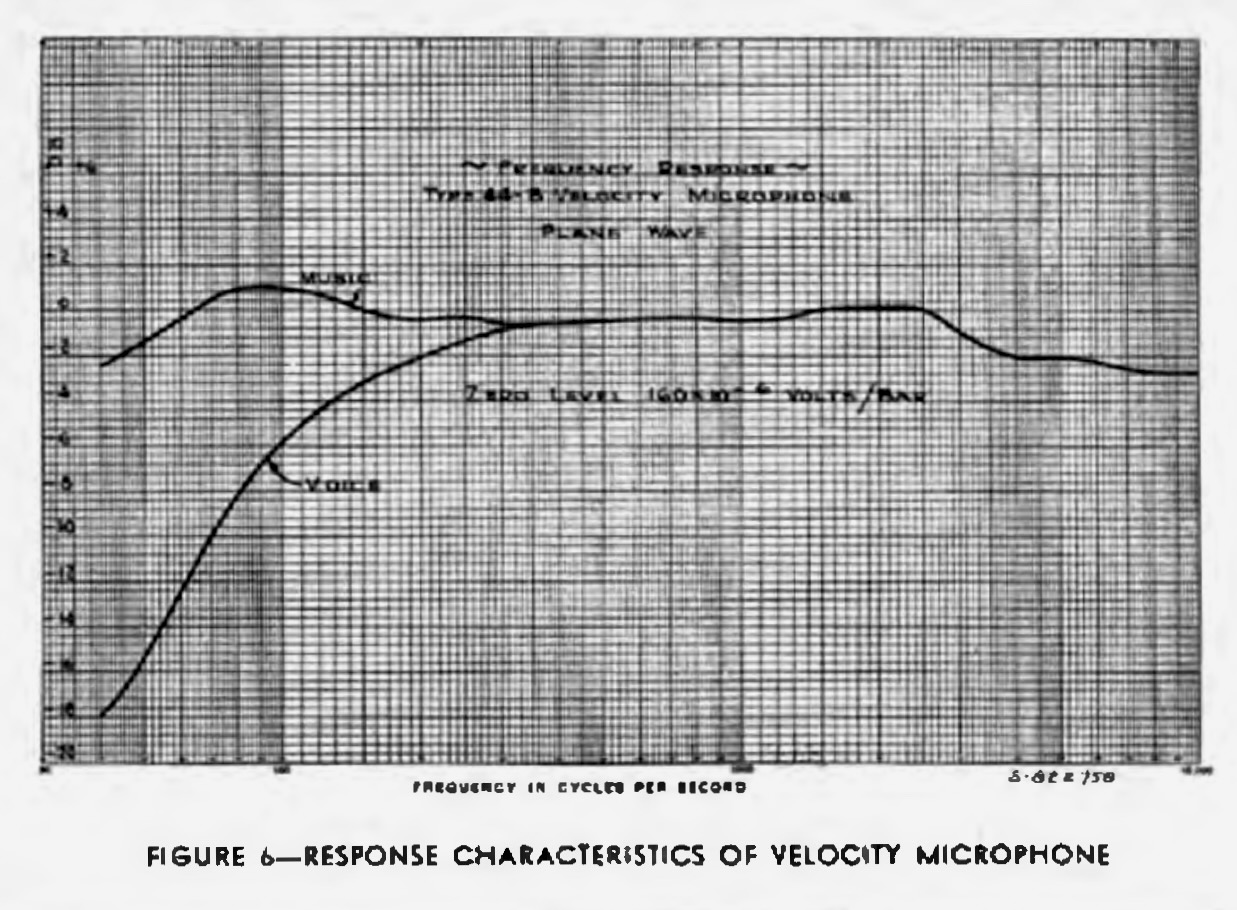
4. QUALITY OF RESPONSE - The operating range of the microphone extends from 30 cycles to 15,000 cycles. When a velocity microphone is placed close to a source of sound, the low frequency response is accentuated. In view of this fact, provision is made in the MI-3027 microphone to enable the user to alter its frequency response in such a manner as to suit best the particular purpose desired; viz., the pick-up of voice (i.e., within 2 feet of the microphone), or the pick-up of music (which takes place at greater distances from the microphone). Emphasis is here placed on the fact that this feature of the MI-3027 microphone is not provided with the intention that such alterations in frequency response be made at will; i.e. between scenes; but is furnished for the sole purpose of supplying a microphone with the best possible characteristics for voice pick-up or for musical pick-up. It is recommended that the frequency response be adapted to either of these types of pick-up and the use of the microphone be restricted to that type of pick-up only.
To alter the frequency response proceed as follows: A small circular hole will be found in the cover plate of the transformer casing. Through this hole will be visible the letter "V" (voice) or the letter ”M" (music), depending on whether the microphone is at the time adapted for voice pick-up or for musical pick-up. Voice pick-up requires the use of a jumper (upon which appears the letter "V"), which is to be placed across the two terminals marked "U" (music), located on the terminal block within the transformer housing. Access to this terminal block is obtained by removing the cover plate of the transformer housing. When the jumper "V" is used, it connects a reactor in parallel with a part of the transformer winding (when the 250 ohm output connections are used), or with all the transformer winding (when the 50-ohm output connections are used). A response curve taken with and without the "V" jumper is shown. As will be observed from examination of this curve, there is a sharp decline at the low frequency end of the curve when the "V" jumper is used. It is to be noted that this curve was taken in a plane wave field, and that the curve is flat when the speaker is located at a distance of 1 ft from the microphone.
5. DIRECTIONAL CHARACTERISTICS - One of the most Important characteristics of the velocity microphone is its directional property. Since the ribbon Is suspended in free space, sound waves approaching the microphone from a direction in the same plane as the ribbon have no effect upon it. Sound waves FROM EITHER DIRECTION along an axis perpendicular to the piano of the ribbon have the maximum effect.
The frequency response chart above shows the MI-3027-E in green, compared with a pair of 44BX microphones. The repsonse is effectively the same within the tolerances expected for microphones of this era.
Frequency Response:
Impulse Response File:
Impulse Response file of the RCA MI-3027E ribbon microphone.
RCA_3027E_IR.aiff