BBC Marconi Type AXBT
Manufacturer:
BBC MarconiModel:
Type AXBTCountry of Manufacture:
United KingdomMicrophone Type:
RibbonPolar Pattern:
Figure 8Production Start Year:
1934Production End Year:
1959Rarity:
4
Microphone History:
Developments in microphones have included substantial improvements in, and a reduction in the size of, the ribbon microphone, and the re-appearance of the electrostatic microphone (previously abandoned because of the unreliability of earlier pre-war models). Advances in design and performance have resulted partly from increased understanding of the basic principles and partly from the availability of improved materials, particularly magnetic materials.
In 1939, the standard studio microphone was the B.B.C.- Marconi ribbon microphone type A. This was modified in 1943 by the addition of a new typed balanced wiring, and designed type AXB. In 1944 the permanent-magnet system was altered and a Ticonal magnet substituted. Microphones of this type were known as type AXBT and had improved sensitivity.
From the BBC website (via the Internet Archive)
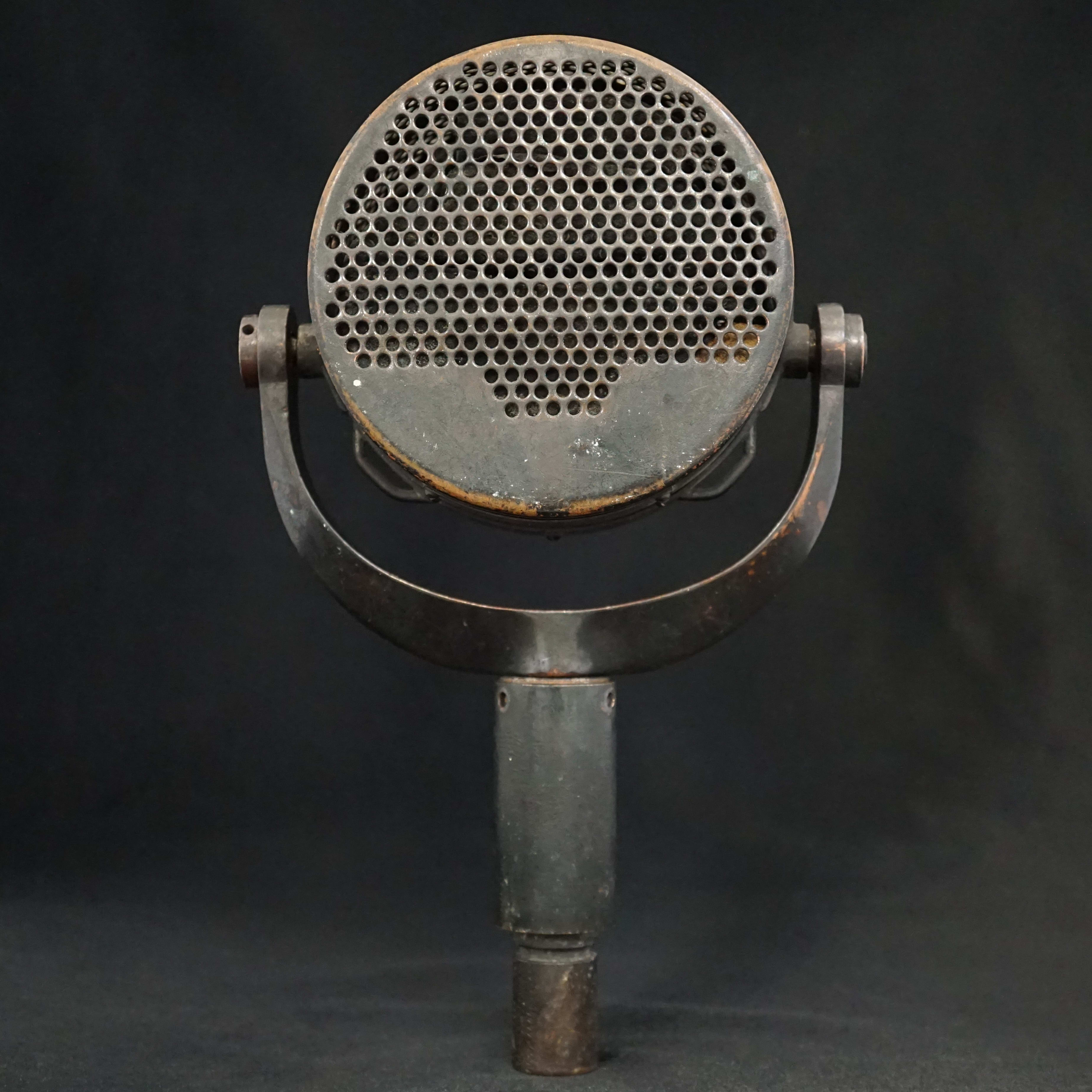
The AXBT was the 4th generation design of the original Marconi Type A microphone (X, B and T representing improvements) widely used by the BBC from the early 1930s onwards. The ribbon microphone was particularly good in studio situations and the double-sided design which accepted sound from front and back but not from the side was particularly suited to voice. It also gave the microphone its characteristic shape, which has entered popular culture as a symbolic image of broadcasting, as well as being the icon for audio in nearly all computer software.
From Roger Beardsley, quoted at Coutant.org
The original Type A used an aluminum ribbon with a vicious resonance and was quickly replaced by a much thinner ribbon. That was then designated the Type AX. In 1943, the internal wiring was altered to reduce interference from electromagnetic fields and became the Type AXB. (Shades of the UK version of the RCA 44?) By 1944, the magnet assembly was changed to a Ticonal type with a 6-dB increase in output. This was the final version and was designated Type AXBT. That version had a large “T” on the side of the casing.
Momics Note: The example in our collection bears the inverted 'T' markings described by Mr. Beardsley, making it an AXBT.
Prime Minister Neville Chamberlain is pictured below speaking into a BBC Marconi AX (From Wireless World September 1937 p 316).
Technical Description:
From the BBC Technical Instructions, 1936, Division 2.1. (Type AX)
The microphone consists essentially, see Figure 1, of a thin corrugated ribbon of " hard aluminium " approximately 2"' Iong, 1/4" wide and .0002" thick suspended in the gap formed by the specially shaped soft steel pole pieces of a large cobalt steel permanent magnet. The field in the gap is parallel to the surface of the strip and at right-angles to its length and is sensibly uniform. The ribbon is held at either end in non-magnetic supports and is only lightly tensioned. Its natural frequency occurs in the region of 20 Hz and the movement is heavily damped by the magnetic field, which is of the order of 1,600 gauss. Movement of the ribbon in response to the sound, in a direction normal to its face, gives rise to current along its length. The resistance of the ribbon is only about 0.15 ohm and a mu-metal transformer, forming part of the microphone assembly, is provided in order to step-up the output impedance to approximately 300 ohms.
The output level from the microphone itself is -74db, zero level being one volt output for a pressure wave of one dyne per square centimetre. This is 4 db below that of the S.T. & C. moving-coil microphone with its associated 3:1 step-up transformer.
Operation
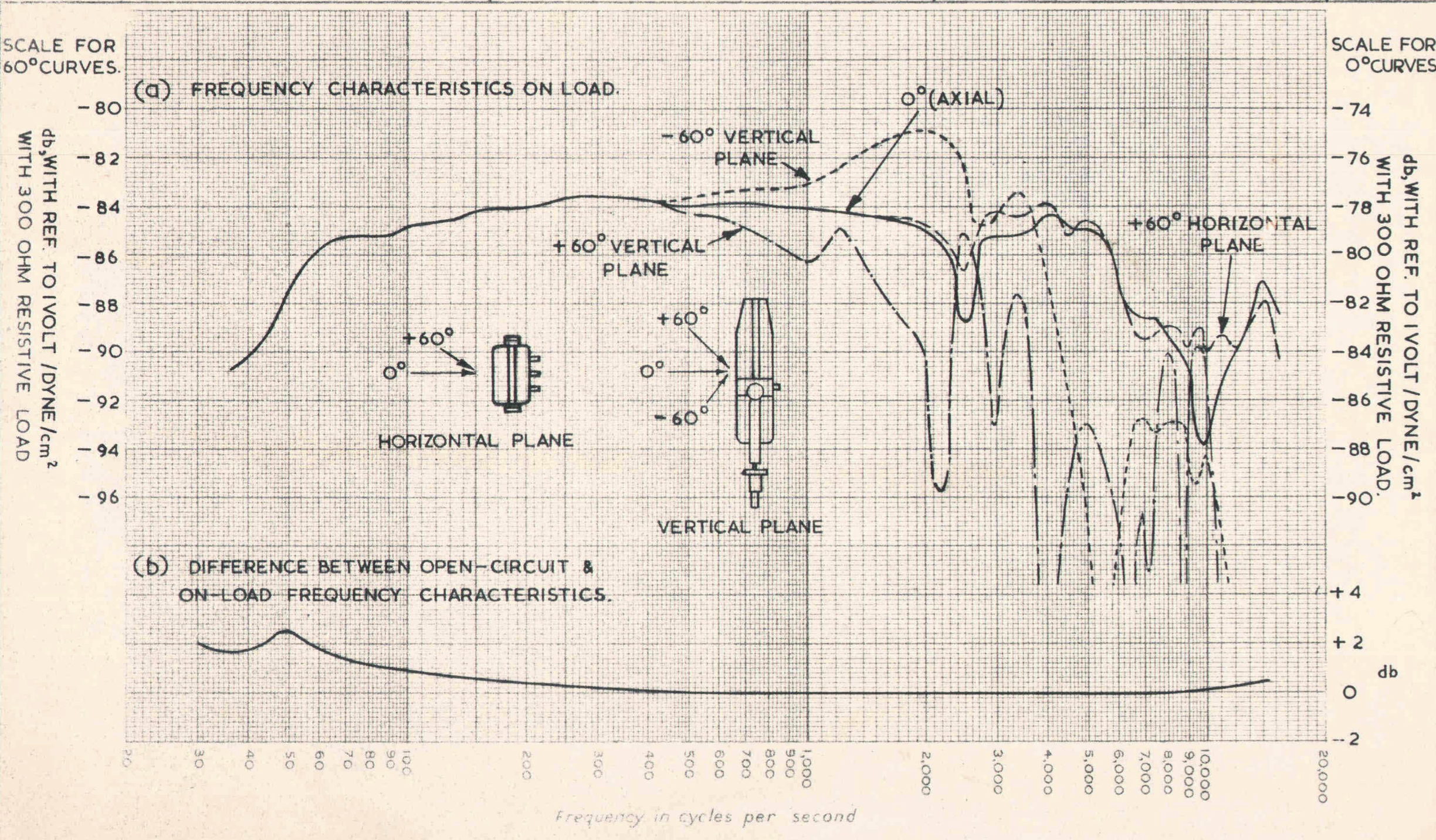
The action of the microphone is not the same over the whole of the frequency band. Up to about 4,500 Hz it operates as a velocity microphone, above this frequency and up to about 9,000 Hz it operates as & pressure microphone, while above 9,000 Hz it functions on the velocity principle again. The combination of the velocity and pressure effects described, gives an extremely good frequency characteristic which is uniform to ±0.5 db between 100 Hz and 6,000 Hz, -2 db. at 7,000 to 8,000 Hz and -3 db. at 9,000 Hz, the present limit of accurate measurement.
There is however good reason to believe that the frequency response is well maintained up to at least 16,000 Hz. Below 100 Hz there is a rise in response with decreasing frequency, with a maximum at 20 Hz, amounting to +4 db. at 50 Hz.
Frequency Response:
Further Reading:
An archive of BBC technical instructions for their ribbon microphones and other equipment.
A description of the Type A series of microphones at the ORBEM website.
A discussion of the Type A microphones at the Coutant website
The photograph of Ingrid Bergman in 1955 and Charles de Gaulle in 1941 are public domain and supplied by Wiki Commons.
The AXBT is compared to the later PGD and PGS models in this BBC document from 1953,