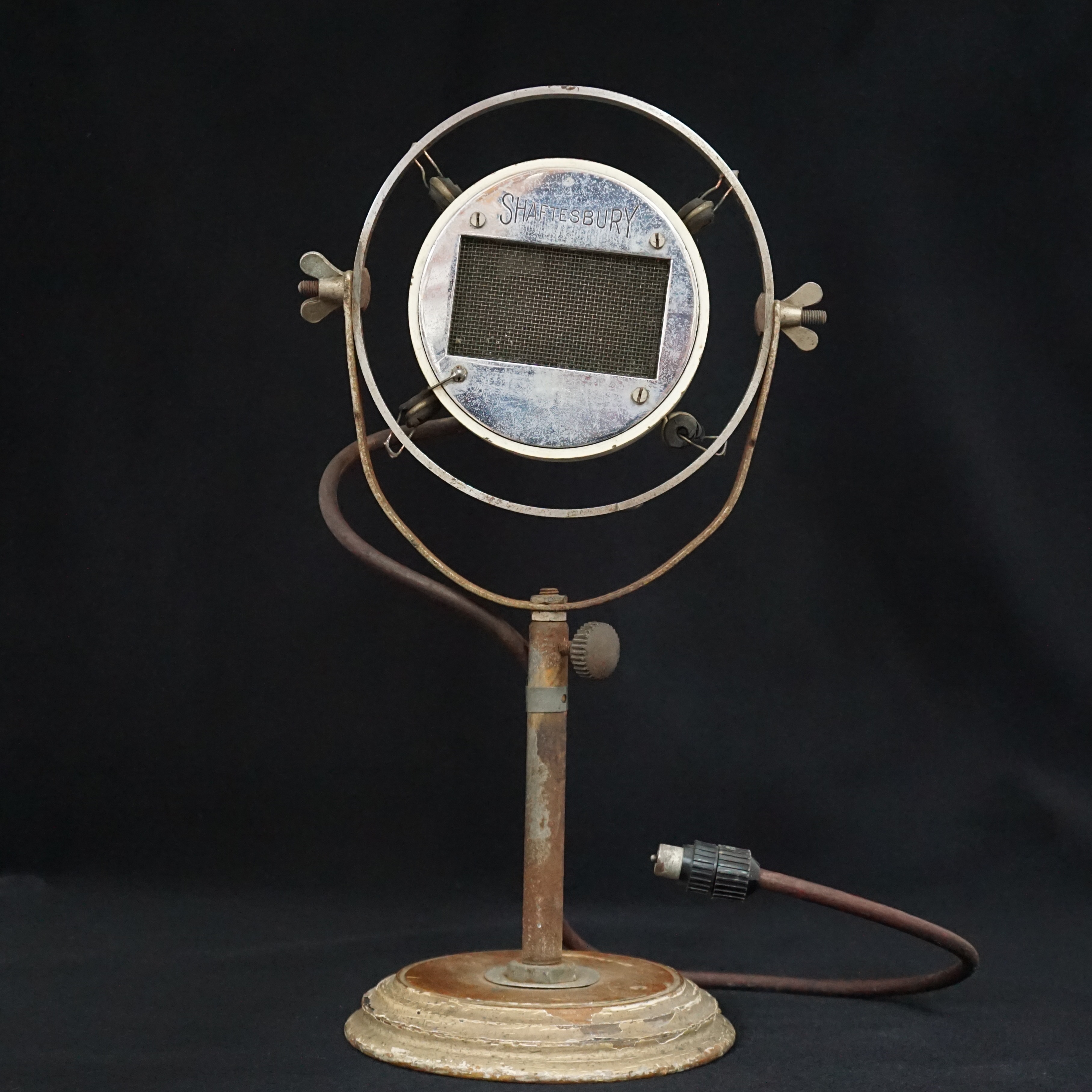
M.R. Supplies "Minor" no.406
Manufacturer:
M.R. SuppliesModel:
"Minor" no.406Country of Manufacture:
United KingdomMicrophone Type:
CarbonPolar Pattern:
OmnidirectionalProduction Start Year:
1935Production End Year:
1937Rarity:
5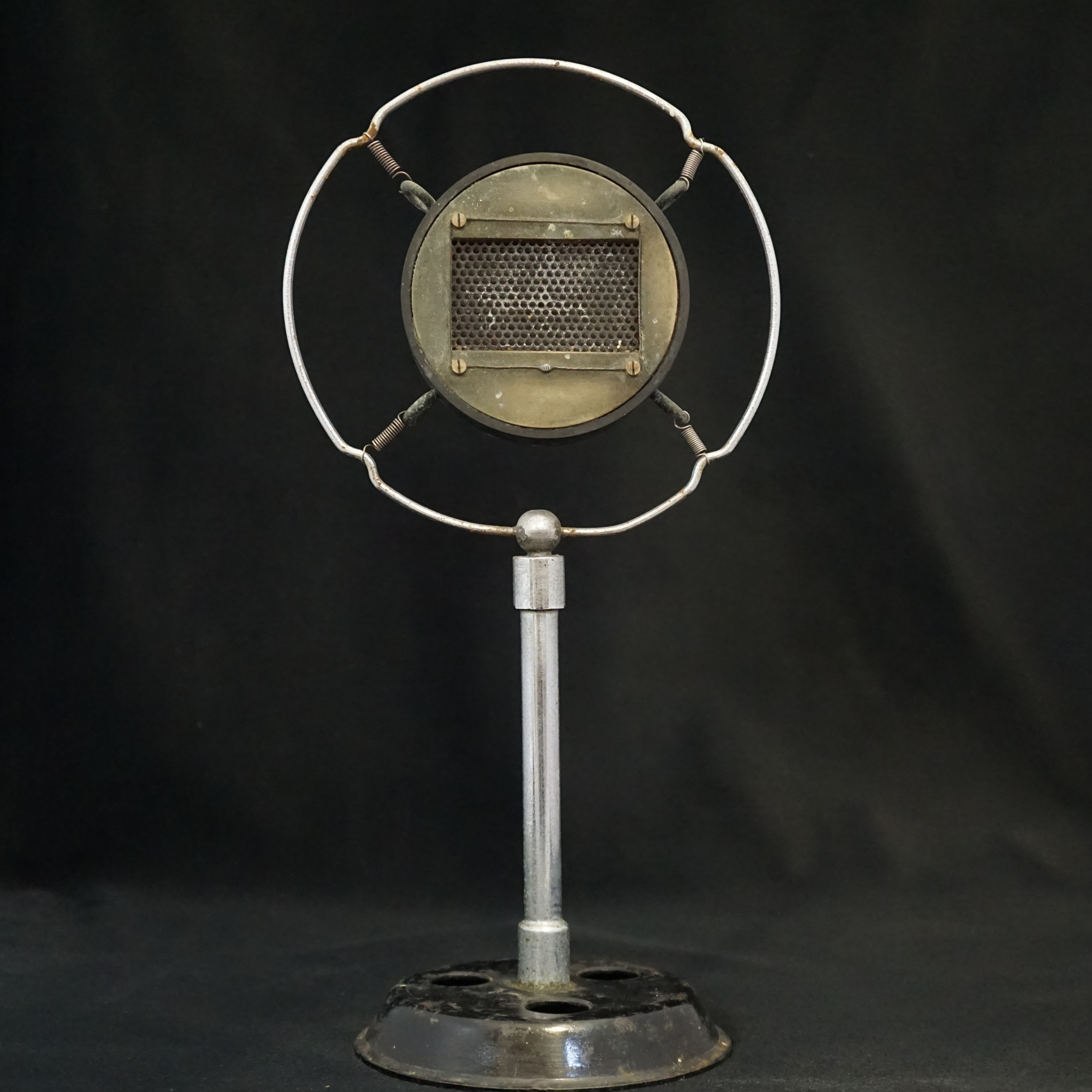
Audio Recording:
Speech (male) recorded with the M.R. Supplies Carbon microphone.
Multiple quality options available
Microphone History:
From Wireless World, April 1935, page 335:
"Mr. M. Rogers, formerly of Shaftesbury Supplies, has commenced business on his own account under the style of M.R. Supplies, at 29a,Charing Cross Road, London proposes to concentrate on microphones, amplifiers, mains gear, and television apparatus."
Mr Rogers clearly had a cordial relationship with his employer, as he offered Shaftesbury models for sale rebadged with his own brand.
Technical Description:
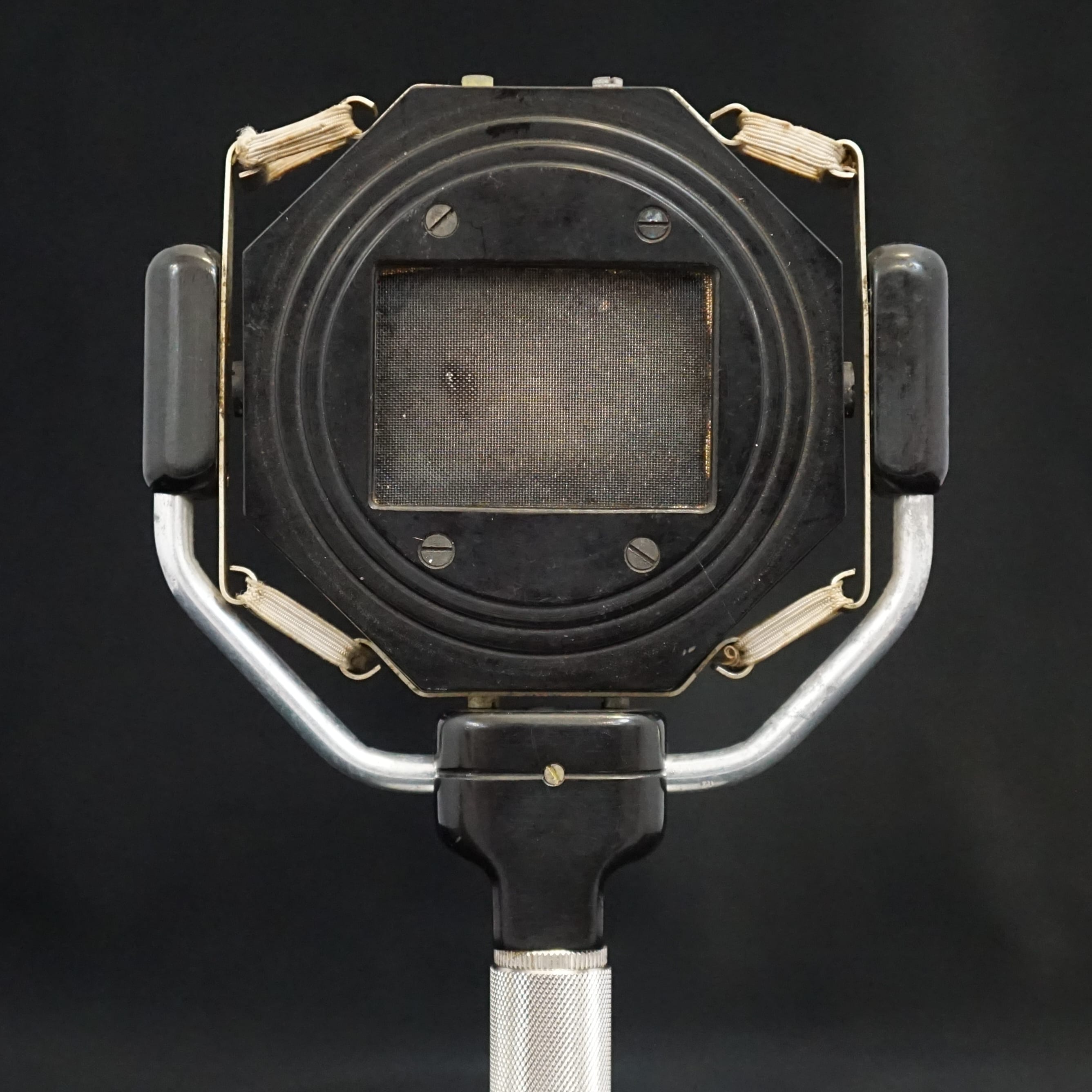
This is a simple yet elegant carbon microphone suspended within a mounting ring by four springs. This is typical of 1930s carbon microphone technology and was made by, or at least distributed by M.R. Supplies of London, who also made (or sold) valve amplifiers.
From Wireless World, February 1937 page 144:
"There can be little doubt that the carbon microphone has many advantages to justify its undoubted popularity with manufacturers of PA equipment. It is sensitive and has an admirable frequency characteristic, particularly when of the transverse current type. A microphone of the transverse current type built to a design described in this journal and housed in an octagonal polished aluminium case is marketed by M.R. Supplies."
"The Minor, which is the latest addition to the range of microphones made by M.R. Supplies, 11 New Oxford Street, London, W.C.1 is a transverse current carbon model assembled in a moulded bakelite case. As the electrical portion of the microphone is thoroughly insulated this model is recommended for use with amplifiers which have provision for obtaining the microphone polarisation from the HT line.
High insulation is particularly desirable also when the amplifier is of the universal AC/DC kind. The specimen submitted for test has a much higher resistance than is usual for this type of microphone, as it is of the order of 2,000 ohms. Consequently with six volts, and this seems quite sufficient for most purposes, the current through the microphone is only 3 mA. One advantage of being able to operate the microphone with such a small current is that the background noise is exceptionally low.
For our tests with this microphone we used the transformer Type MR/221 which is designed for their transverse current microphones, and which has a primary inductance of approximately 0.9 Henry. Aural tests revealed that the microphone and transformer gave very good reproduction at the higher frequencies, but while no noticeable resonance could be detected the introduction of a little high note attenuation was not undesirable for the reproduction of speech. On music, however, advantage can be taken of the wide frequency range of the microphone, and the amplifier operated with virtually a flat characteristic.
The Minor microphone has a very attractive appearance as the case is a polished black moulding with plated suspension hooks and front cover.It costs 37s. 6d., and the price of the MR/22r transformer is 11s. 6d."