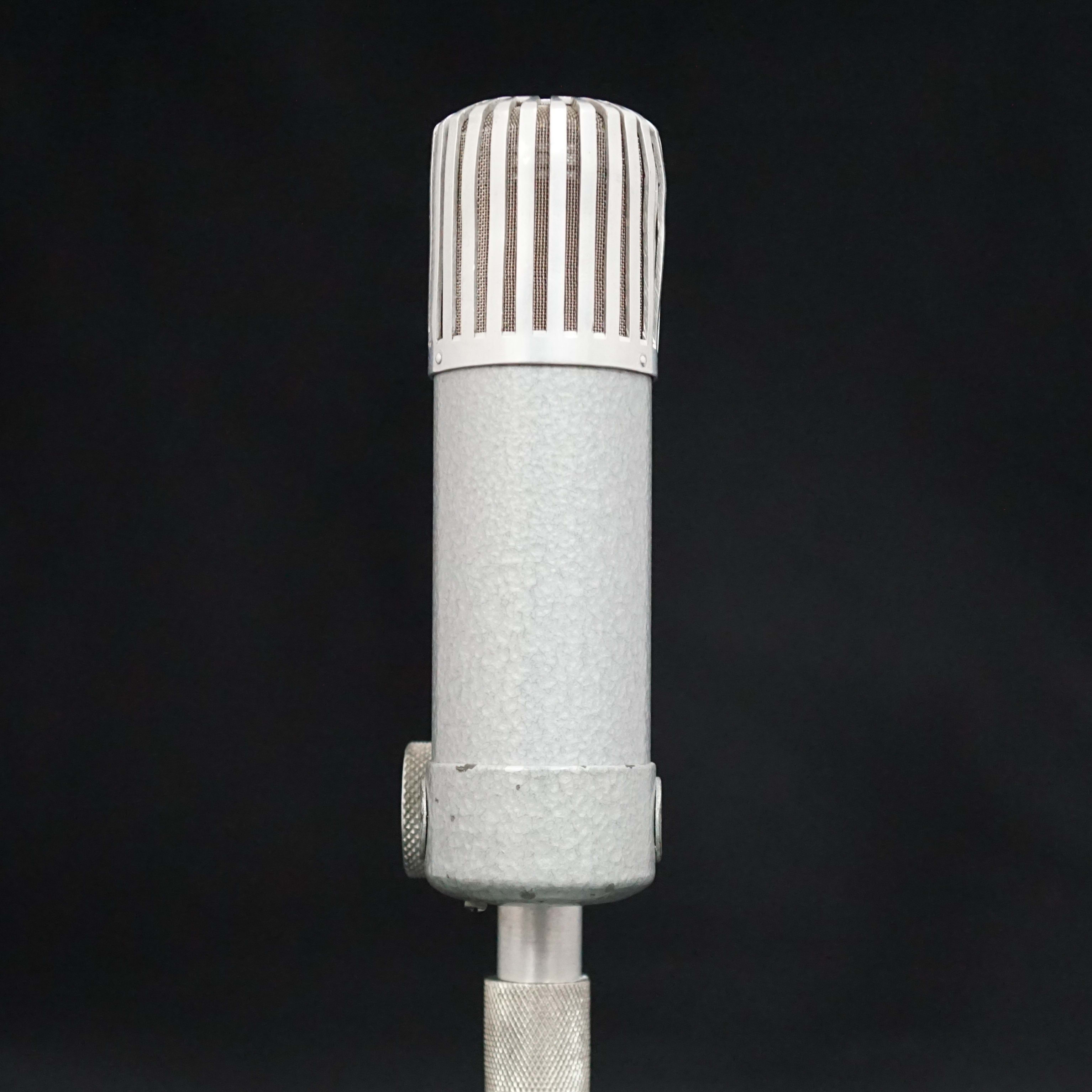
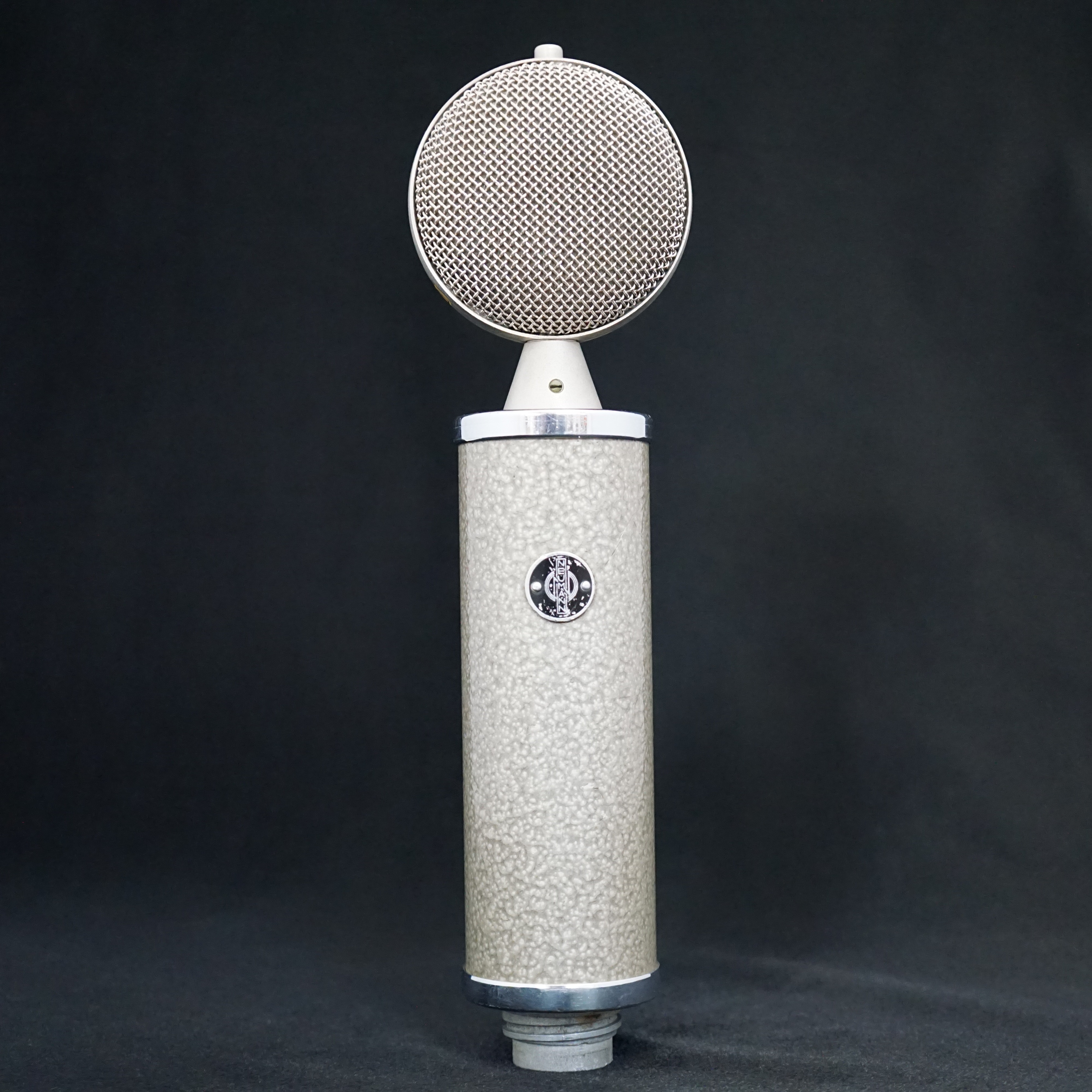
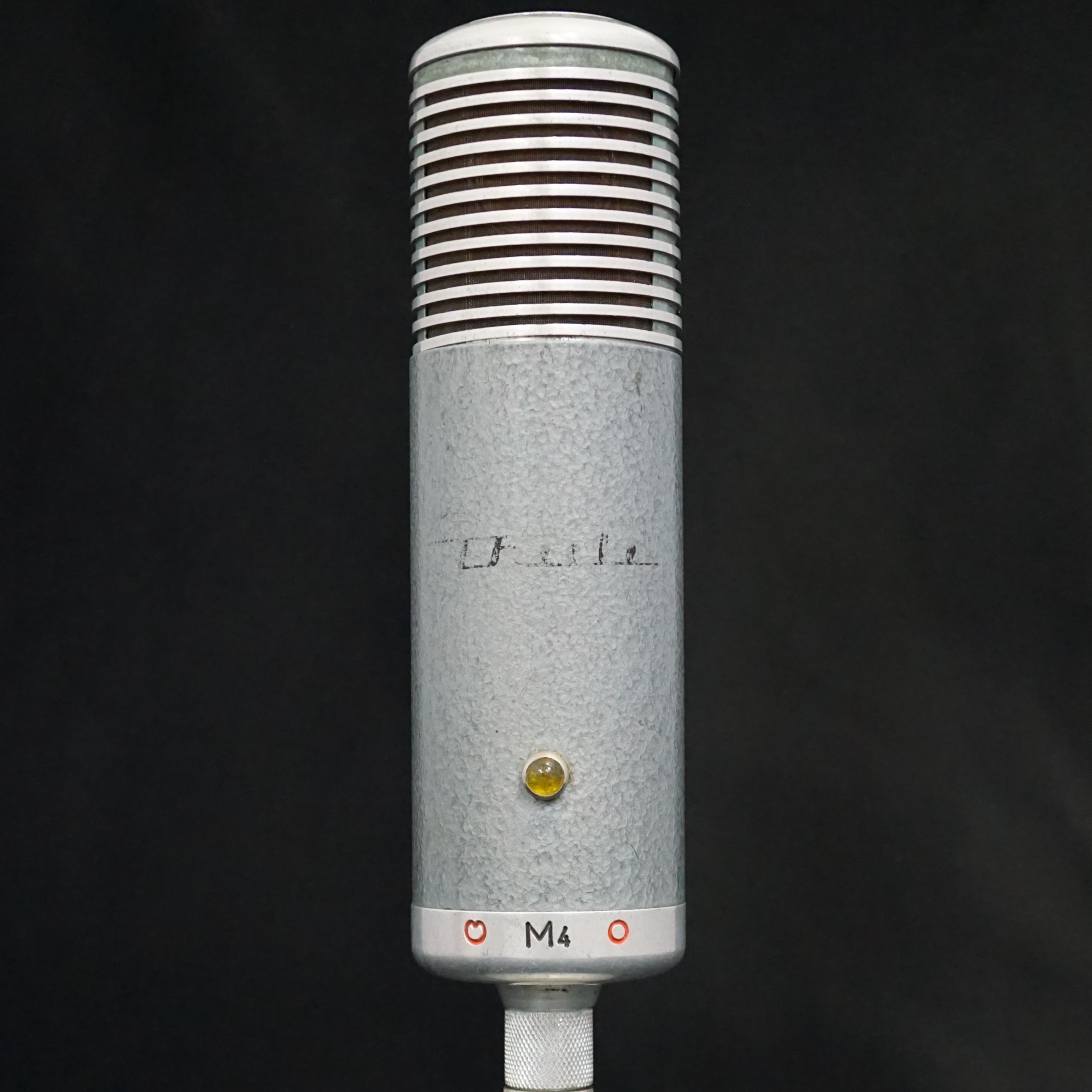
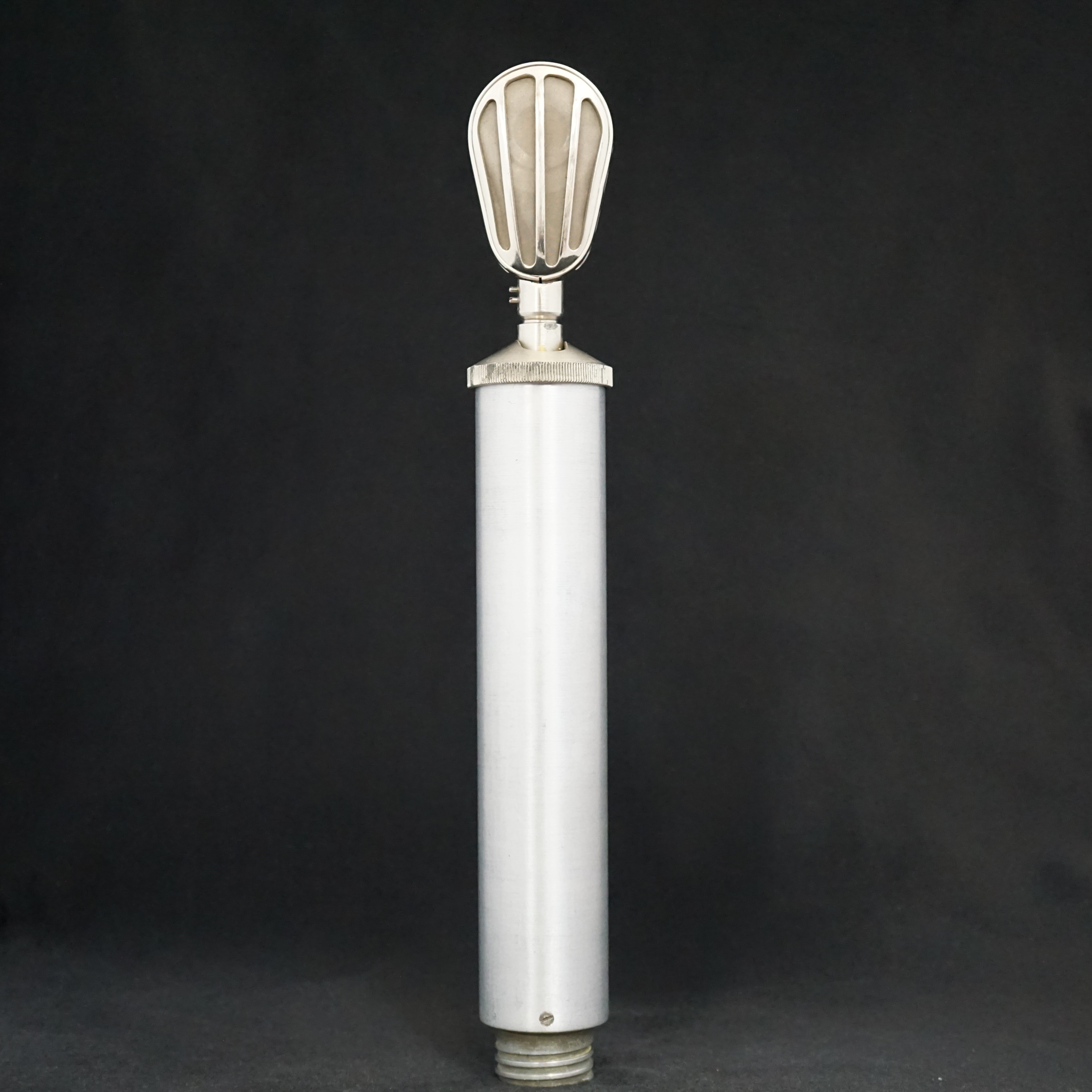
Reissmann MR50
Manufacturer:
ReissmannModel:
MR50Country of Manufacture:
GermanyMicrophone Type:
CondenserPolar Pattern:
OmnidirectionalProduction Start Year:
1953Rarity:
4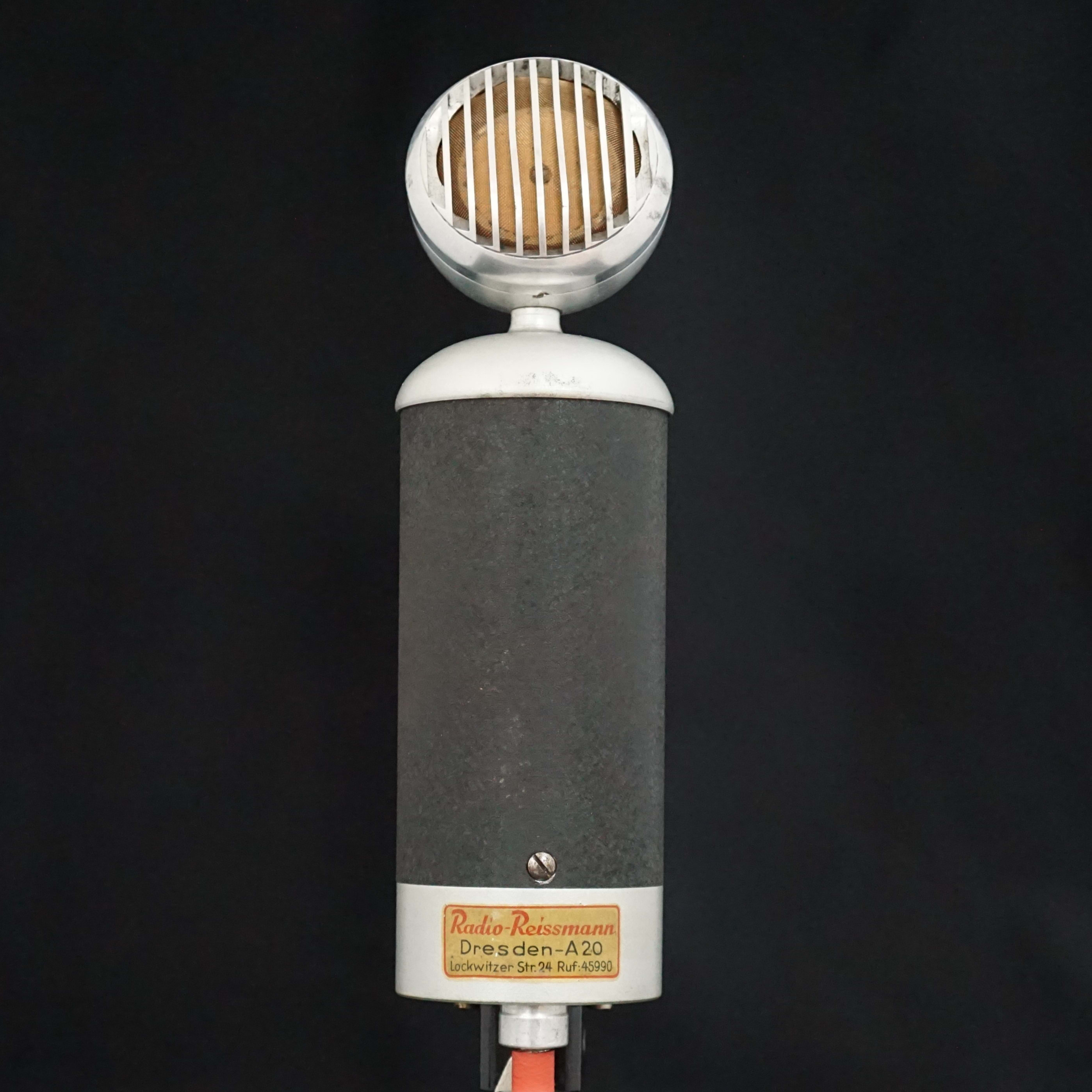
Microphone History:
1937: Gerhard Reißmann begins his career as a radio mechanic at VEM Sachsenwerk in Radeberg. During World War II, he works as a production controller at the Filmosto company in Dresden. Alongside his main job, he repairs radios in his parents' apartment at Ostbahnstraße 24.
1943 – March: Gerhard Reißmann opens his first shop at Falkenstraße 2 in Dresden. Since he continues to work at Filmosto during the day, he runs the shop in the evenings, starting at 5:00 p.m. During this time, he primarily repairs radios and military equipment.
1944 – November 1: Gerhard Reißmann is drafted into the German Navy and initially stationed in Pillau near Königsberg (East Prussia). He is later transferred to Denmark. During the bombing of Dresden on February 13, 1945, he is not present and receives no information about the fate of his pregnant wife and son. His wife, Irmgard, and his sons survive the firestorm unharmed. Jürgen is just over a year old at this time; Bernd is born later that same year.
1945: After the war ends, he is released from captivity in Denmark and travels back to Dresden via Bavaria. There, he discovers that both his apartment at Maternistraße 2 and his business at Falkenstraße 2 have been completely destroyed by the air raids of February 1945.
1946: January: Despite the difficult post-war period, he dared to make a fresh start and reopened his business at Lannerstraße 4 in Dresden. Here, he resumed repairing and assembling radios.
1952: Gerhard Reißmann developed and manufactured his first portable 5-watt tube amplifier. This marked the beginning of the production of amplifier systems, which were used especially by bands and entertainers such as the Dresden Dance Symphony Orchestra, Fred Herfter, Sikora, and Fips Fleischer.
1956: Due to increasing demand, Gerhard Reißmann expands his production facilities to include three additional locations: Lockwitzer Straße 22, Mockritzer Straße 4, and Lockwitzer Straße 26. At the end of 1958, he discontinues the sale of spare parts and radio and television sets to focus entirely on the development and manufacture of electroacoustic devices. The company grows to approximately eight employees.*
1958: The product range is continuously expanded. In addition to mixing console amplifiers, column microphones and condenser microphones with stands are added. Furthermore, the development and production of school radio systems for educational institutions and companies begins. The entire product range is presented at the Leipzig Spring and Autumn Fairs – initially with its own booth, later with support from government organizations.
1972: The East German government carried out forced nationalization, and the company was transferred to VEB Elektromechanik Dresden. Gerhard Reißmann thus lost control of the company he had founded. The state-owned enterprise was located at Elsa-Brandström-Straße 3.
MoMics note - one of our microphones is labelled with the address Lockwitzer Straße 24 - which sits in between the two properties mentioned above
Technical Description:
Technical description and specification translated from original German adverts:
Condenser Microphone MR 50
The highly sensitive MR 50 condenser microphone is a beautifully designed precision instrument used for the transmission of musical and spoken performances. The diaphragm—the heart of the microphone—is an extremely thin gold-coated foil under tension. Thanks to the specially shaped fixed backplate, the microphone achieves very high sensitivity and the widest possible frequency response. The device contains a single-stage preamplifier, ensuring correct signal level for any standard power amplifier or broadcast unit. The required DC supply voltage of approx. 120 V and 3 mA should be taken from the end of a suitably dimensioned rectifier chain. With AC heating, this must be symmetrically arranged. The MR 50 condenser microphone is a highly sensitive precision device and requires careful handling to maintain its full performance. It should be protected from strong mechanical shocks, vibration, and moisture.
Technical specification:
- Construction: Gold foil diaphragm, edge-tensioned, in aluminium housing Built-in preamplifier
- Intended Use: For high-quality music and speech reproduction
- Polar Pattern: Omnidirectional
- Tube Complement: 1 × EF 12
- Sensitivity: Capable of driving any standard power amplifier or radio unit
- Frequency Response: Linear from 40 to 10,000 Hz
- Output Impedance: 50 kΩ
- Cables: Up to 5 m, shielded, without intermediate transformer
- Supply Voltages: DC supply approx. 120 V / 1 mA
- Heater voltage 6.3 V / 200 mA
- Connector Pins: (1) Heater, (2) Ground, (3) Heater, (4) Grid, (5) Free, (6) Anode
- Dimensions: Total length: 230 mm, Diameter: 60 mm
- Weight: 650 g
- Stand: A microphone stand can be supplied on request
- Price: On request (handwritten note: 250)
MoMics technical note:
As far as we can tell, neither the MR50 nor the MR51 was supplied with a separate stand alone power supply. Instead, they were powered from the DIN socket of a Reissman power amplifier (pictured) which provided 120V DC and 6V AC power for the heater. The microphones do not have internal output transformers - the signal is instead piggy-backed on top of the high voltage DC supply, to the next amplification stage. This would likely be a noisy arrangement in a modern studio, but was undoubtedly good enough for public address duties at the time.